

Why Invest in Software Maintenance for Long-Term System

At SKM Group, we often tell our clients that building software is only the first chapter of the story. The rest of the book is the software maintenance process—the continuous effort required to keep your system healthy, secure, scalable, and aligned with your business goals. While development might feel like a sprint, maintenance behaves more like preventive healthcare. You’re not only reacting to issues; you’re ensuring your digital ecosystem stays resilient no matter how your business grows.
Professional software maintenance services exist to give you control, clarity, and continuity. Their objective is to ensure your product maintains high performance levels while protecting your financial investment. At SKM Group, we frame maintenance around business outcomes, not technical jargon. You want stability. You want speed. You want compliance. And you want your software to scale as your business scales.
The goals of maintenance revolve around creating long-term leverage. You safeguard user experience. You reduce operational risk. You align your systems with industry standards and emerging technologies. You maintain interoperability between modules and external services. Most importantly, you extend the lifespan of your digital assets—delaying or eliminating the need for costly rebuilds.
Truly effective software maintenance services empower you to trust your system’s performance under pressure. That trust becomes a competitive advantage, especially in sectors where downtime equals financial losses or reputational damage.
The deeper your digital footprint, the more important software maintenance management becomes as part of IT governance. It’s the structure that ensures your systems follow internal policies, industry regulations, and security requirements. Without a well-defined governance framework, maintenance becomes chaotic and reactive. With it, your organization operates with discipline and predictability.
Maintenance management helps you enforce documentation standards. It defines escalation paths. It clarifies acceptance criteria for updates. It ensures that every change—whether small or large—creates value rather than technical debt. At SKM Group, we often see companies thrive once they formalize how decisions are made and how maintenance tasks are prioritized.
Above all, good software maintenance management aligns technology decisions with business strategy. Instead of guessing what should be updated or when, you follow a roadmap that supports growth, compliance, and operational efficiency. You avoid fragmentation. You avoid inconsistencies. You avoid the silent accumulation of risk.
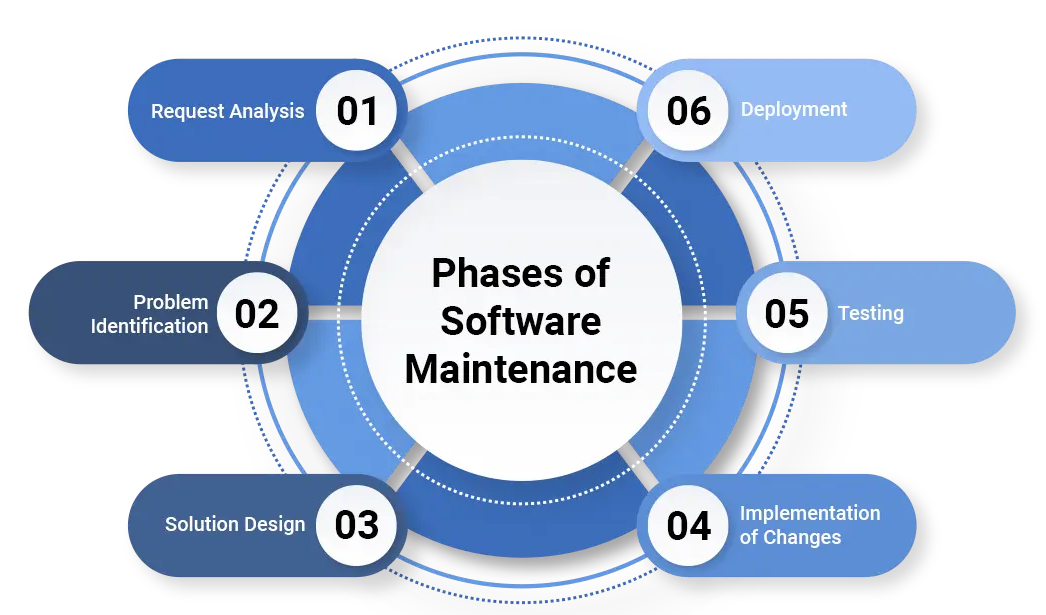
Most companies gradually learn that different types of software maintenance serve different objectives. Some keep the lights on; others help you evolve. Understanding the nuances lets you invest wisely and shield your business from unnecessary disruption.
Reactive maintenance focuses on fixing issues after they occur. It’s essential, but it’s also the least strategic option because failures often cost time and money before you even start repairing. Preventive maintenance strengthens the foundation of your system so that failures are less likely to happen. By auditing code, removing bottlenecks, optimizing workflows, and improving architecture, you create stability.
Adaptive maintenance keeps your platform relevant. You update libraries, frameworks, APIs, and integrations so the system continues running smoothly in ever-changing environments. Nothing in the technology world remains static, so adaptive maintenance ensures your system remains compatible with new protocols, operating systems, security standards, and hardware.
A balanced plan weaves together these three categories so that your system stays functional, secure, and ready for future demands. Each one supports the health of your digital ecosystem from a different angle.
Take control of your digital future with SKM Group’s trusted IT services.
Reliability is not an accident. It’s the cumulative result of consistent updates, smart monitoring, early detection, and long-term planning. A strong software maintenance service reduces downtime, minimizes system errors, and eliminates vulnerabilities before they spread. If your business depends on the system’s uptime to serve customers, reliability becomes a core strategic metric.
Every small update plays a role. Patches close security holes before attackers can exploit them. Performance tuning prevents overloads during peak usage. Architecture refinement ensures your application can withstand changing user behaviors. These refinements accumulate over time, shaping a stable environment that moves with you instead of holding you back.
When done right, maintenance reduces stress on your internal teams. You spend less time fighting fires and more time focusing on growth. And because reliability directly affects user satisfaction, your customers feel the difference immediately.
The financial side of maintenance is often misunderstood. Many organizations underinvest early, only to pay exponentially more when systems break, degrade, or require total rebuilding. At SKM Group, we frequently remind clients that maintenance is not a cost—it’s cost control.
Think of the expenses you avoid: emergency interventions, downtime-related revenue loss, compliance penalties, cybersecurity breaches, and dramatically higher redevelopment costs. Preventive and adaptive maintenance ensure you always operate ahead of risk rather than behind it.
There are also measurable savings. Routine updates optimize performance and reduce the infrastructure footprint. Refactoring eliminates inefficiencies that slow your team down. Documentation and governance reduce the time needed to onboard new partners or team members. And automated monitoring reduces manual workloads that would otherwise accumulate.
When you view maintenance as a financial lever rather than a burden, the ROI becomes clear. You protect the value of your software investment while maintaining operational continuity and maximizing lifecycle benefits.
Focus on strategy while we handle the tech through IT outsourcing.
Selecting the right maintenance software programs requires more than just comparing features. You’re choosing long-term tools that will influence your workflows, your reporting capabilities, and the efficiency of your operations. At SKM Group, we advise clients to focus on strategic alignment rather than brand popularity. The right solution should complement how you work—not force you to reinvent your processes.
You want software that scales with your business. You want a platform that integrates with your existing tools. And you want clarity: intuitive dashboards, actionable data, and reliable automation. Many companies underestimate the importance of modularity, yet modular tools allow you to grow capabilities without replacing the entire system.
A few universal priorities include:
Choosing well gives you visibility and resilience. It lets you centralize your maintenance efforts, streamlining tasks that were previously fragmented across teams or tools.
Timing matters. Scheduling software maintenance services at the right intervals prevents performance dips, unexpected failures, and security vulnerabilities. The schedule depends on your system’s complexity, usage pattern, and integration landscape, but one principle remains universal: maintenance should never be an afterthought.
You should plan regular updates to stay ahead of industry changes. For example, security standards evolve quickly, and outdated libraries can become major liabilities. Seasonal business fluctuations also influence scheduling. If your system experiences traffic spikes, you should strengthen it before demand peaks.
Your maintenance calendar should also include milestone-based updates. When you launch new features, connect new systems, or expand your infrastructure, maintenance ensures compatibility and stability. SKM Group clients often adopt hybrid schedules—part time-based, part event-based—to ensure full coverage.
A disciplined schedule creates predictability. You reduce risk, keep costs stable, and ensure your platform remains aligned with your operational needs throughout the year.
Modern factories run on data. When you integrate maintenance software programs with SCADA systems, you create a unified environment where equipment behavior, system alerts, and performance metrics flow into one operational layer. This integration allows you to see the full picture—machine states, process conditions, and predictive indicators—without jumping between platforms.
For manufacturing teams, this significantly reduces response times. Instead of waiting for breakdowns, you detect early deviations that signal potential problems. Synchronization between SCADA and maintenance software for manufacturing ensures that every alert becomes a structured action. Your technicians receive precise instructions. Your supervisors gain full traceability. And your production flow becomes more stable.
The real value lies in coordination. Integrated systems reduce blind spots and give your team a shared source of truth.
Monitoring Equipment Health via Maintenance Software for Manufacturing
Good equipment health is the backbone of efficient production. With maintenance software for manufacturing, you can continuously monitor vibration levels, temperature patterns, load metrics, runtime hours, and other critical signals. These indicators reveal when machines are drifting from optimal conditions long before they fail.
Real-time health monitoring transforms maintenance culture. Instead of reacting to downtime, your team anticipates it. Instead of dealing with catastrophic failure, you handle minor adjustments. And instead of conducting inspections blindly, you operate with evidence-based precision.
Over time, monitored patterns reveal deeper insights about equipment lifespan, production bottlenecks, and usage cycles. These insights support smarter budgeting, more accurate scheduling, and better procurement decisions.
Transform your operations with smart, scalable custom software development.
Automating Work Orders in Software Maintenance Services
Automated work orders streamline manufacturing operations by removing manual inefficiencies. When a maintenance trigger appears—whether from SCADA, sensors, or system logs—your software generates a work order instantly. You assign tasks automatically. You confirm resource availability. You enforce compliance steps without additional administrative effort.
For many SKM Group clients, automation becomes a turning point. It standardizes maintenance workflows, ensuring consistent execution regardless of shift changes, staff turnover, or workload fluctuations. It also reduces errors: technicians always know what to do, what parts to use, and which procedures to follow.
Automation frees your team from repetitive tasks so they can focus on strategic improvements rather than paperwork.
Data Analytics and Predictive Maintenance Techniques
Data is the new fuel for operational efficiency, especially in manufacturing environments. When you combine analytics with maintenance software for manufacturing, you unlock the ability to forecast failures, optimize workflows, and reduce waste. Predictive models evaluate historical performance patterns, identify anomalies, and determine when components are likely to fail. Instead of relying on routine checkups, you respond based on evidence.
At SKM Group, we help clients use statistical modeling, sensor data aggregation, and machine-learning algorithms to understand system dynamics in real time. Predictive maintenance ties together machine behavior, usage intensity, and environmental conditions. The more accurately you analyze these inputs, the more precisely you can plan maintenance interventions. You protect equipment lifespan, reduce operational uncertainty, and support continuous improvements across the production cycle.
Predictive tools become even more valuable when integrated into dashboards. You can track patterns visually, identify hotspots instantly, and act before slowdowns become disruptions. Over time, the predictive engine becomes your hidden advantage—catching issues you can’t see manually and guiding data-driven decision-making.
Compliance Tracking within Manufacturing Maintenance Workflows
Every regulated industry depends on traceability. If your factory operates in sectors like pharmaceuticals, food production, automotive, aerospace, or energy, compliance is non-negotiable. Integrating compliance workflows into your maintenance ecosystem ensures every intervention is documented, every technician action is logged, and every system change meets industry standards.
Strong compliance capabilities within software maintenance services help you manage audits without stress. Instead of scrambling for records or reconstructing histories, you access complete trace logs with one click. Maintenance procedures, component changes, calibration cycles, and safety verifications become part of a transparent and normalized process.
For manufacturing teams, this reduces liability and strengthens governance. You know exactly who performed a task, what parts were replaced, which steps were followed, and when the process was approved. Automated compliance tracking also ensures that mandatory inspections happen on time, safeguarding both product quality and plant safety.
ROI Metrics for Maintenance Software for Manufacturing
A well-implemented maintenance software for manufacturing solution delivers measurable returns. To justify your investment, you need metrics that capture both short-term and long-term value. At SKM Group, we help clients track KPIs that reveal how maintenance affects production continuity, cost structure, and operational performance.
Meaningful ROI indicators include asset uptime, maintenance cost per unit produced, failure frequency reduction, inventory efficiency, and equipment lifespan extension. You get a clear picture of how your maintenance strategy contributes to profitability. When your system operates more reliably, production becomes smoother, costs become more predictable, and waste becomes easier to eliminate.
Over the long run, strong ROI comes from the compounding effect of fewer breakdowns, improved resource planning, and smarter capital expenditures. Instead of replacing machinery prematurely, you maximize asset longevity. Instead of dealing with unpredictable failures, you manage them proactively. This stability becomes a strategic advantage in competitive industries.
Smaller organizations often assume maintenance systems are reserved for larger enterprises. In reality, maintenance software for small business provides structure, transparency, and control that even startups need. When your resources are limited, every hour of downtime carries greater risk. Having the right tools prevents operational chaos and promotes disciplined growth.
Small businesses benefit from centralized issue tracking, automated updates, and simplified documentation. Maintenance becomes a predictable process rather than a disruptive fire drill. You manage your assets systematically, whether they include hardware, digital platforms, IoT devices, or internal applications. You also gain insights that help you budget with confidence—knowing when upgrades are necessary and when they can be deferred.
As you scale, your maintenance tools scale with you. Instead of replacing systems or reinventing workflows, you build on top of a reliable foundation. For many small businesses, this is the moment maintenance evolves from an expense into an enabler of expansion.
DevOps thrives on speed, automation, and collaboration. Yet none of these advantages matter if you neglect the stability of your software foundation. This is where software maintenance management fits seamlessly into the DevOps pipeline. It ensures every release is supported, every update is validated, and every environment remains consistent.
Maintenance aligns with DevOps principles by providing automated patching, continuous monitoring, and version governance. When your development and operations teams share a unified maintenance framework, deployment risks shrink significantly. You build, release, and maintain products with discipline, reducing friction between teams.
This integration also enhances observability. Monitoring tools track application performance across environments, providing instant insights for diagnostics. Maintenance workflows handle configuration drift, dependency updates, and compatibility checks. Your pipeline becomes more efficient because you maintain strong control over your software assets—not just during deployment, but throughout their operational lifespan.
Corrective maintenance is your first line of defense when system issues arise. It includes bug fixes, security patches, and adjustments that restore your platform to expected behavior. While corrective maintenance is reactive by nature, it remains essential for operational stability. Even well-designed systems encounter unpredictable flaws, and you need rapid response procedures to resolve them.
A structured corrective workflow ensures that every issue is analyzed, prioritized, and resolved methodically. You maintain system quality while preventing minor problems from growing into major outages. You also protect user experience, which is often the most vulnerable asset when bugs appear unexpectedly.
Perfective Maintenance: Enhancements and Performance Tuning
Perfective maintenance focuses on improving your software beyond its original requirements. It’s where your system evolves to support better performance, superior usability, and higher efficiency. This includes UI improvements, workflow refinements, architectural upgrades, and performance tuning across the stack.
When you invest in perfective strategies, your platform adapts to user expectations and business expansion. You remove inefficiencies, eliminate friction, and optimize load handling. Perfective maintenance becomes a catalyst for innovation—helping your system stay relevant in a fast-moving market.
Adaptive Maintenance: Platform and Environment Updates
Technology ecosystems change constantly. Operating systems update, libraries deprecate, APIs evolve, and browsers overhaul their rendering engines. Adaptive maintenance ensures your software remains compatible with all these moving parts. This often involves version upgrades, protocol adjustments, and integration updates.
Without adaptive maintenance, systems gradually drift into obsolescence. You experience unexpected errors, security gaps, or integration failures. By staying current, you protect your platform from environmental decay and maintain seamless operation across devices and services.
Preventive Maintenance: Risk Mitigation Strategies
Preventive maintenance is about preparing your system for a future you can’t fully predict. It includes code refactoring, architecture cleanup, log analysis, vulnerability scans, and performance audits. By identifying early warning signs, you eliminate hidden risks before they transform into downtime.
Preventive strategies offer long-term financial benefits because they reduce emergency repair costs and extend system lifespan. You maintain tight control over your technical debt and keep your infrastructure flexible enough to support future enhancements.
Emergency Maintenance: Crisis Response Plans
Even the best systems face unforeseen crises: sudden outages, cyberattacks, broken integrations, or corrupted data. Emergency maintenance helps you respond quickly, minimizing damage and restoring normal operation. A strong crisis plan includes incident detection, escalation paths, recovery steps, and communication protocols.
Emergency maintenance is your safety net. It ensures your team knows exactly how to act when the unexpected happens. The faster you respond, the faster your business recovers.
Tools and Techniques for Managing Each Maintenance Type
Each maintenance category benefits from specialized tools, but the underlying principles remain consistent. You want real-time visibility, structured processes, and reliable automation. The right mix of monitoring dashboards, ticketing systems, CI/CD integrations, analytics tools, version control, and environmental management platforms helps you maintain discipline across the entire maintenance landscape.
You create a strong feedback loop between detection, diagnosis, and resolution. You reduce manual work. You gain full traceability. Over time, your tools become the ecosystem that keeps your software stable, compliant, and performance-ready.
Investing in software maintenance is investing in resilience, innovation, and long-term competitiveness. You protect your systems from decay. You create a controlled environment where updates strengthen rather than destabilize your platform. You reduce downtime, maintain compliance, and support the continuous evolution of your business.
When you work with SKM Group, you gain a partner who treats maintenance as a strategic discipline—not an afterthought. You get a roadmap, structure, and measurable outcomes. You get proactive protection and clarity instead of reactive firefighting. And most importantly, you ensure that your technology remains an asset capable of powering your growth for years to come.

The core categories include corrective, adaptive, perfective, preventive, and emergency maintenance. Each type serves different goals—from fixing bugs to improving performance, managing compatibility, preventing failures, and responding to crises.
Costs depend on system complexity, technology stack, integration requirements, and service scope. Predictable subscription models are common, while enterprise systems often require custom long-term contracts.
Yes. By integrating monitoring tools, automating work orders, and using predictive analytics, manufacturers significantly reduce unplanned outages and extend equipment lifespan.
You should look for centralized issue tracking, automated updates, reporting dashboards, simple configuration, and scalable workflows that grow with your business.


In our team, Dominik Bigosiński is responsible for driving the growth of online businesses through the strategic use of content. As an expert in his field, he has collaborated with organizations from the US, UK, Norway, and Poland since 2018, contributing to the development of over 100 blogs and supporting more than 450 B2B and e-commerce brands worldwide. His passion for conscious personal growth and philosophy is reflected in his work, where he focuses on delivering thoughtful, audience-centered strategies that drive long-term results.
Hire our experienced IT experts. Flexible, effective, and ready to start.
Discover moreStrategic insights into technology, software development, and digital growth
At SKM Group, we often tell our clients that building software is only the first chapter of the story. The rest of the book is the software maintenance process—the continuous effort required to keep your system healthy, secure, scalable.

The speed of change is ruthless. Systems that once powered your business can quickly become the anchors that hold it back. At SKM Group, we’ve seen this story unfold across industries.

Technology moves fast. Your clients move faster. And when systems stop working, even for a moment, your business feels the weight instantly. That’s where an IT Helpdesk becomes.

When you're steering a tech-driven business, every dollar invested in software must work harder and smarter. Outsourcing lets you harness global expertise while minimizing overhead and accelerating delivery timelines.

If you're evaluating how to accelerate digital initiatives while staying lean, software development outsourcing delivers a precise answer. By partnering with external experts, you tap into specialized skills and proven delivery processes

Nearshore Software Development Outsourcing is the strategic delegation of software engineering tasks to external teams located in neighboring or nearby countries. It’s not just about saving money—it’s about alignment.

Evaluate an outsourced development team for your legacy stack. Cut sprint delays, reduce IT overhead by 30%, and integrate .NET engineers in 6 weeks..

Software Development Nearshore refers to outsourcing your software projects to teams in neighboring or nearby countries. It's a model that balances cost-efficiency with strategic proximity.

Software outsourcing means handing over your software development to an external partner, often located in another country or region. It’s not just about cutting costs—although that's a common reason.

In 2025, selecting the right Software Development Outsource Company is no longer just a matter of cost—it's a mission-critical decision that impacts scalability, security, and competitive edge.

Every modern business relies on technology to stay competitive. But maintaining IT infrastructure, security, and efficiency in-house can be overwhelming and costly. This is where Managed Services in IT come in.

By outsourcing IT operations and infrastructure management to expert providers, companies can focus on their core business activities without the burden of handling complex IT tasks internally.

Technology is the backbone of modern business, and Managed IT Services have become the key to maintaining a secure, efficient, and scalable IT environment. Whether you run a small startup or a global enterprise, Managed IT Service Providers offer.

As a small business owner, you likely wear many hats. From managing operations to driving growth, your plate is always full. That’s where IT outsourcing for small businesses comes in—a strategic solution to offload technical responsibilities

Properly selecting a web development company is one of the most important decisions you must make, significantly affecting your project's success. In the US alone, there are approximately 4.3 million software houses;

Discover the world of .NET development in this comprehensive guide. Learn what a .NET developer does, the skills needed, and the importance of .NET technology in building scalable and reliable applications.

Discover effective strategies for managing IT costs in a rapidly changing technological landscape. Learn how flexible budgeting, forecasting, and prioritizing investments can help businesses save money while enhancing profitability and competitivenes

Discover why soft skills are as vital as technical expertise for programmers. Explore the growing importance of communication, collaboration, and empathy in software development.

Explore the pros and cons of desktop, remote, and hybrid work models in the IT industry. Learn how these models impact productivity, employee satisfaction, and competitive advantage, with a focus on IT outsourcing and custom software development.

Discover the environmental impact of the IT industry, from carbon emissions and energy consumption to raw material extraction and e-waste. Learn how sustainable practices can mitigate these effects, leading to a greener digital future.

Navigating remote work and IT outsourcing? Discover how to leverage the cultural and geographic diversity of international teams to drive innovation while addressing common challenges.

Inclusive software enhances user engagement and promotes a positive brand image, making it a strategic business asset. Create inclusive software designs that cater to all users, regardless of their abilities, age, or cultural background.

Discover how IT outsourcing revolutionizes HR management, enhancing agility and efficiency. Explore benefits like cost reduction, access to global talent, and streamlined processes.

Discover the importance of accurate technical skills assessment in IT recruitment. Explore methods like technical interviews, online tests, live coding, and homework assignments.

Explore the role of soft skills in diverse IT roles, from programming to client interactions, and learn how they contribute to effective collaboration, innovative problem-solving, and lasting client relationships.

Learn best practices for managing your IT outsourcing team and turning challenges into growth opportunities. Learn about the different types of outsourcing contracts
.avif)
Ready to revolutionize your IT strategy? Learn the top 5 factors for choosing the perfect outsourcing partner. How can understanding your business needs drive IT success? Who are the key players in the global IT outsourcing market?

In the tech world, companies often face a common problem - employees leaving. This is especially tricky when it comes to IT developers. As the need for specific skills grows and the competition for the best IT experts gets tougher.

In the dynamic landscape of software creation, where innovation and efficiency are paramount, the concept of IT outsourcing has emerged as a strategic alternative that's catching the attention of businesses worldwide.
.avif)
In the landscape of the software industry, the success of a business hinges on its ability to assemble the right team with the right skills.One of the questions on every tech entrepreneur's mind: how do you get the best talent on board?

Comments