


While our Step-by-Step Tutorial explains how developers work, this checklist is designed specifically for business leaders and managers. Instead of focusing on coding details, it outlines what to expect at each phase, which deliverables to approve, and how to ensure your investment in software development yields measurable ROI. Following this approach reduces risks, avoids unnecessary spending, and gives you a clear framework for decision-making throughout the project lifecycle.
A structured process is the backbone of predictable outcomes. By defining clear phases, objectives, and deliverables, you minimize the risk of scope creep, missed deadlines, and budget overruns. Each phase acts as a checkpoint where progress is measured, and decisions are validated. This not only protects your budget but also ensures that your software aligns with business goals, meets market needs, and maintains high quality from start to finish. In essence, a structured process turns uncertainty into a controlled, trackable investment.
The planning and discovery phase is where your project sets its foundation for success. By defining phase-specific objectives, your team establishes clear goals for scope, budget, and risk management before writing a single line of code. At this stage, decisions about feature priorities, technology stack, and project constraints are made collaboratively with stakeholders. This is also where feasibility studies and cost estimations ensure your project is viable and aligned with business objectives. For insights on the cost of development, see our detailed analysis.
Key Deliverables in Phase 1:
Design and prototyping translate abstract requirements into tangible experiences. By visualizing the solution early, stakeholders can validate assumptions, test user flows, and give feedback before development begins. This stage significantly reduces rework costs and ensures the product delivers an intuitive user experience. High-quality prototypes also make it easier to align your team on design choices, preventing confusion during development and ensuring brand consistency across digital products.
Key Deliverables in Phase 2:
Core development is where your vision becomes reality. Using a software development task list to manage the backlog ensures every feature is implemented according to priority, and progress is measurable through sprints or iterative builds. A clear task list helps teams focus on high-value items, avoid scope creep, and maintain code quality. For projects like modernizing legacy systems or building a new custom software solution, this phase ensures delivery on time, on budget, and aligned with business objectives.
Key Deliverables in Phase 3:
Quality Assurance (QA) ensures your software performs reliably under real-world conditions. Beyond simply finding bugs, QA validates that the product meets functional, performance, and security requirements. For more on the software testing importance, see our dedicated article. Rigorous QA processes reduce post-launch maintenance costs, protect your reputation, and guarantee that end-users have a seamless experience. By integrating QA throughout development, you catch issues early, avoiding cascading problems that could impact timelines and budgets.
Key Deliverables in Phase 4:
Deployment is more than releasing software—it’s preparing your business and users for a reliable, supported system. Maintenance ensures long-term value by addressing issues, releasing updates, and providing ongoing support. An SLA defines response times, uptime expectations, and support scope, giving you peace of mind. Leveraging a dedicated development team at this stage ensures operational continuity, faster response to incidents, and maximized ROI from your software investment.
Key Deliverables in Phase 5:
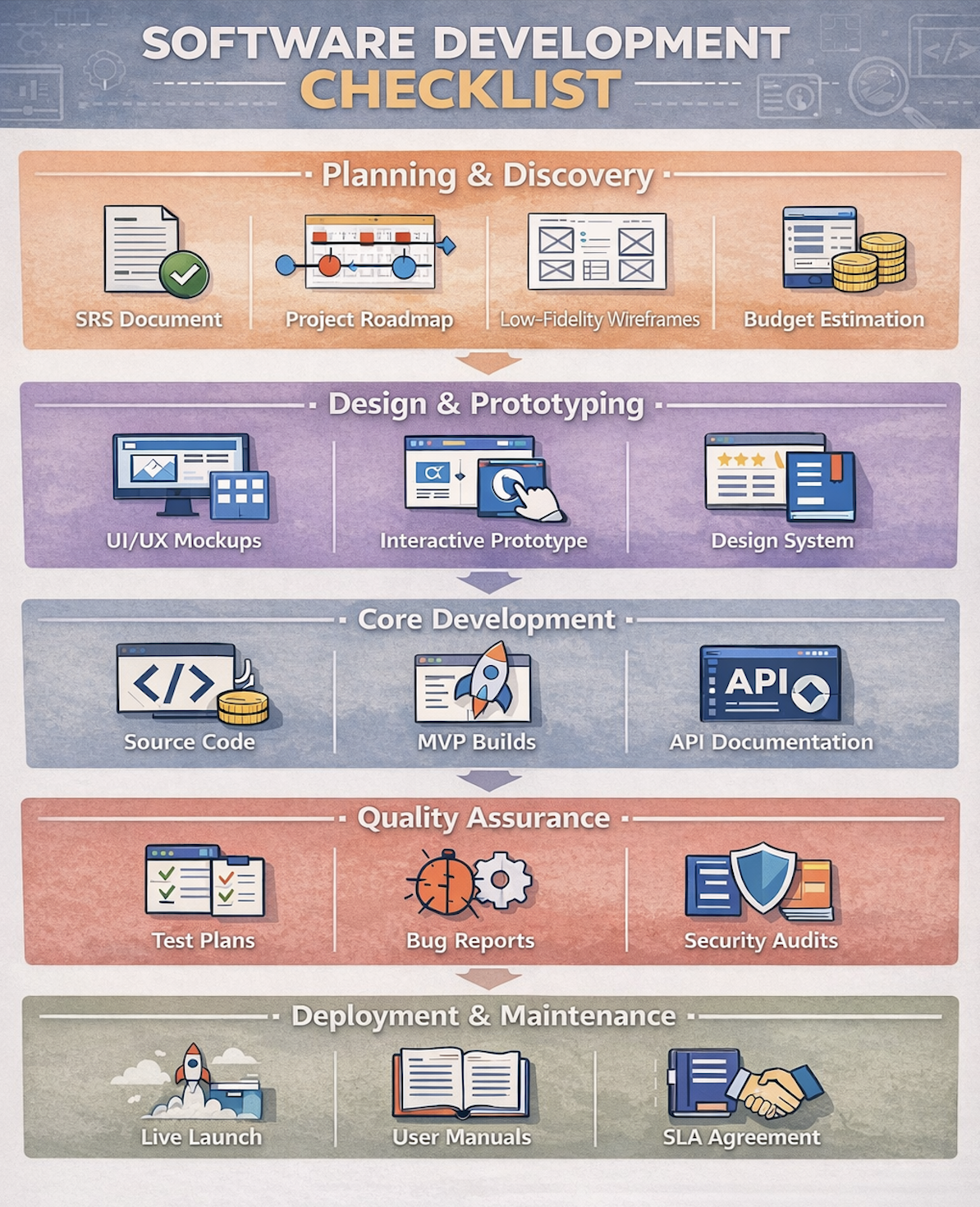
This checklist offers a high-level overview of your software development project, helping business leaders quickly assess progress, validate deliverables, and ensure maximum ROI. Use it as a decision-making tool to identify potential risks early, track budget adherence, and confirm that each phase aligns with your strategic objectives.

Software development usually follows several major phases: planning, analysis, design, development, testing, deployment, and maintenance. Each phase serves a specific function in ensuring a structured and high-quality result. Together, they create a roadmap for managing complex projects effectively. Skipping or rushing any stage can lead to major setbacks and increased costs.
The planning phase defines the project’s objectives, scope, budget, and timeline. It also identifies potential risks and outlines resource allocation. Proper planning establishes a foundation for communication between stakeholders and developers. Without this stage, projects often experience misalignment and inefficiency.
During analysis, developers gather detailed requirements from users and stakeholders. This helps define functional and non-functional needs that the software must fulfill. The analysis ensures that development aligns with real business problems. Accurate analysis reduces misunderstandings and rework later in the project.
The design phase transforms requirements into technical specifications and visual models. Architects define system structure, while designers focus on user experience and interface. This phase balances performance, usability, and scalability. A strong design ensures smooth development and easier maintenance later.
Testing verifies that the software works as intended and meets user expectations. It identifies bugs, performance issues, and security vulnerabilities before release. Multiple testing types—unit, integration, system, and user acceptance—ensure comprehensive coverage. Thorough testing minimizes post-launch problems and user complaints.


Mateusz is a seasoned professional in project management and software development. He is currently CEO at SKM Group, where he oversees projects and programmers, ensuring their successful execution. Additionally, he plays a vital role in shaping corporate strategy, driving product development, and spearheading business development and key account management efforts.
Need tailor-made software? We build scalable, secure solutions from scratch.
Discover more
Comments
Some of the phases feel a bit high-level – maybe a part 2 with examples?
The post does a good job outlining the phases, but in my experience with agile methodologies, these phases often overlap and iterate. Perhaps a note on how this checklist applies in more iterative environments would be helpful.
Solid overview on software development, but I noticed there's little mention of security considerations throughout the phases. In today's environment, security can't be just a testing phase activity but needs to be integrated from requirements through deployment.
Your checklist mentions user acceptance testing, but doesn't go into detail about gathering and incorporating user feedback. This has been crucial for our success - getting real users involved early and often.