


if you are responsible for technology decisions in your organization, you have probably heard both terms used almost interchangeably. Technical debt. Legacy systems. Obsolete platforms. Architectural burden. But here is the uncomfortable truth: they are not the same. At SKM Group, we work with companies that are scaling, transforming, or simply trying to survive in competitive digital markets. And we see it every week – confusion between technical debt and legacy systems leads to the wrong strategic decisions. Teams refactor when they should modernize. They rebuild when they should optimize. They invest millions without fully understanding the root cause.
The technical debt definition is often reduced to a simple metaphor: “code shortcuts taken today that create problems tomorrow.” While accurate, that explanation is incomplete.
In modern enterprise engineering, technical debt represents the accumulated consequences of design and implementation decisions that prioritize short-term delivery over long-term maintainability, scalability, and clarity. It exists inside the system architecture, codebase, infrastructure design, data models, and even in testing strategies.
From a business perspective, technical debt software development is not just messy code. It is architectural compromise. It is deferred refactoring. It is incomplete documentation. It is inconsistent deployment processes.
You should not think of technical debt software as “bad engineering.” In many cases, it is a deliberate economic decision. The problem begins when it becomes invisible, unmanaged, and unmeasured.
At SKM Group, we treat technical debt in software development as a financial liability. Because that is what it becomes over time.
To understand the real technical debt meaning, you must understand trade-offs.
When your team rushes a feature to meet market demand, you gain speed. But you may sacrifice:
That is not necessarily wrong. Sometimes speed wins markets. But every shortcut introduces future friction. And that friction becomes technical debt cost.
The longer the debt remains unmanaged, the more expensive change becomes. Release cycles slow down. Incident frequency increases. New developers require longer onboarding time. Innovation becomes harder.
This is where executives often misunderstand the situation. They see slower velocity and assume team inefficiency. In reality, they are paying compound interest on earlier decisions.
Focus on growth while we manage your technology with reliable IT outsourcing.
Not all debt looks the same. In practice, we identify multiple forms of technical debt in software development, each with different risk profiles.
There is code-level debt, where shortcuts exist in implementation details. There is architectural debt, where system structure limits scalability. There is infrastructure debt, where outdated CI/CD pipelines or cloud configurations create operational instability. There is process debt, where the absence of standards or governance multiplies inconsistencies.
You may also encounter documentation debt, test debt, and data debt. Each of them increases complexity and reduces predictability.
Understanding these distinctions is essential because technical debt management requires different strategies depending on the type.
Let’s speak directly about money.
The true technical debt cost is rarely visible in your financial statements. It hides in extended timelines, delayed product launches, and lost competitive advantage.
From a business standpoint, unmanaged debt results in:
When you consider these factors together, the impact becomes structural, not tactical.
At SKM Group, we help organizations translate engineering constraints into financial language. Because unless you can measure impact, you cannot justify technical debt reduction initiatives.
One of the most important distinctions in technical debt software development is intent.
Intentional debt occurs when you knowingly choose a shortcut. You document it. You plan to address it later. It is a calculated business decision.
Unintentional debt is different. It emerges from lack of experience, weak architectural oversight, or poor code review practices. It accumulates silently.
Intentional debt can be strategic. Unintentional debt is dangerous.
If you are leading digital transformation, your responsibility is not to eliminate all debt. That is unrealistic. Your responsibility is to control it.
Defining Legacy Systems In Enterprise Environments
A legacy system is not simply “old software.” Age alone does not define it.
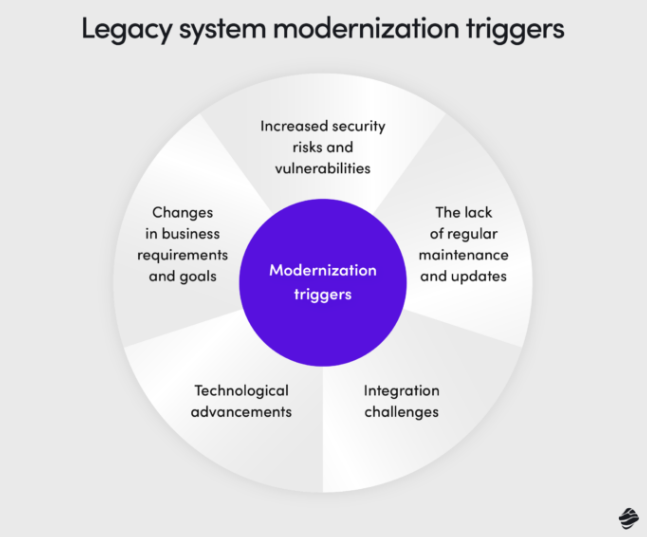
In enterprise environments, legacy systems are platforms that remain critical to operations but rely on outdated technology stacks, obsolete architectures, or unsupported vendors. They are deeply embedded in business processes. Replacing them is risky and expensive.
Unlike technical debt, which can exist in brand-new applications, legacy systems are typically long-standing operational backbones.
At SKM Group, we often encounter organizations where legacy systems run billing engines, logistics coordination, financial reporting, or regulatory workflows. They are stable but rigid.
And rigidity has a cost.
Monolithic Architectures And Outdated Technology Stacks
Most legacy environments are built as monoliths. Business logic, data access, and presentation layers are tightly coupled. Scaling requires scaling the entire system. Deployment is complex and risky.
These platforms often rely on outdated programming languages, old database engines, or unsupported frameworks. Integration with modern APIs becomes difficult. Cloud migration becomes complex.
You may hear stakeholders say, “It works. Why change it?”
The answer lies in adaptability. Stability without flexibility eventually blocks growth.
Infrastructure Constraints And Vendor Lock-In
Legacy systems frequently depend on on-premise infrastructure, proprietary hardware, or long-term vendor contracts.
Vendor lock-in creates limited negotiation power. Infrastructure constraints limit scalability. Modern cloud-native patterns become hard to implement.
From a strategic view, you are not just maintaining software. You are maintaining dependency chains.
This is different from technical debt. Debt can exist inside modern cloud-native systems. Legacy systems are often structural constraints inherited from earlier eras of enterprise IT.
Maintenance Challenges And Skill Gaps
Another common feature of legacy systems is shrinking expertise.
Developers familiar with older languages or frameworks retire or move on. Recruiting new engineers becomes difficult. Documentation may be outdated or incomplete.
As a result, maintenance risk increases. Small changes become high-risk operations.
When this happens, your organization becomes operationally fragile. Not because of a single bug, but because institutional knowledge fades.
Compliance, Stability, And Operational Risk
Ironically, legacy systems are often stable. They have run for years. They process millions of transactions.
But stability does not equal resilience.
Security vulnerabilities, compliance requirements, and regulatory updates evolve constantly. Older systems may not meet modern standards. Integration with contemporary cybersecurity frameworks may be limited.
This is where technical debt cyber security intersects with legacy architecture. Vulnerabilities may not come from poor code quality, but from outdated encryption standards, unsupported libraries, or missing observability tools.
Operational risk grows quietly.
Reimagine your workflows through scalable Custom software development.
Now we reach the heart of the matter.
Technical debt is a condition that can exist inside any system — new or old. It results from development decisions. It can be measured, managed, reduced.
Legacy systems are inherited platforms built on outdated paradigms. They may contain debt, but they are not defined by it.
You can have:
The strategic implication is clear.
If your challenge is primarily technical debt, refactoring and governance may solve it.
If your challenge is legacy architecture, you may need replatforming, reengineering, or full modernization.
Confusing the two leads to misallocated budgets.
At SKM Group, our first step is diagnostic clarity. Because the solution depends on the root cause.
Understanding origins is critical if you want to control future exposure.
In technical debt software development, common root causes include aggressive deadlines, lack of architectural oversight, insufficient testing automation, evolving requirements, and scaling without redesign.
In legacy evolution, causes are more structural: long product lifecycles, acquisition of older platforms, regulatory constraints, and earlier technological limitations.
Many organizations accumulate debt during rapid growth phases. Market expansion outpaces architectural governance. Over time, incremental fixes replace coherent design.
The result is complexity without strategy.
This is where disciplined technical debt management becomes a strategic capability rather than a technical afterthought.
The technical debt quadrant provides a structured way to analyze intent and awareness behind debt creation. It moves the conversation beyond blame.
The model evaluates two dimensions: deliberate vs. inadvertent, and prudent vs. reckless.
Deliberate And Prudent Debt
This is strategic debt.
You choose a shortcut to capture market opportunity. You document the decision. You allocate future time for correction. You understand consequences.
This type of debt is often acceptable. It aligns engineering trade-offs with business objectives.
Deliberate And Reckless Debt
This occurs when teams knowingly introduce poor solutions without mitigation plans.
There is awareness, but no accountability. No backlog entry. No timeline for correction.
Over time, this category becomes expensive. It reflects governance weakness.
Inadvertent And Prudent Debt
Here, teams make the best decision with limited knowledge. Later, new information reveals suboptimal architecture.
This often happens during innovation or experimentation.
The key is detection and response. Once identified, prudent organizations prioritize remediation.
Inadvertent And Reckless Debt
This is the most dangerous category.
It stems from lack of expertise, weak review processes, or absent standards. Teams create fragility without knowing it.
This is where proactive audits and structured technical debt measurement become essential.
In enterprise settings, the technical debt quadrant becomes a governance tool.
You can classify backlog items. You can evaluate architectural decisions. You can align business stakeholders with engineering realities.
It transforms emotional debates into structured analysis.
At SKM Group, we integrate quadrant thinking into architecture reviews and transformation roadmaps. Because without classification, you cannot prioritize.
Theory is useful. But you make decisions based on reality.
Let’s translate definitions into concrete technical debt examples and tech debt examples that we encounter in enterprise environments.
Imagine a fast-growing e-commerce platform. To meet seasonal demand, the team duplicates pricing logic across multiple services instead of extracting a shared module. It works. Revenue grows. But later, every pricing change requires synchronized updates in five places. That is classic technical debt in practice — duplication that increases change cost.
Consider a financial services company where automated tests were postponed to accelerate initial launch. Two years later, regression testing before each release takes three weeks. Releases slow down. Business innovation stalls. That is debt in test coverage.
Another example: a SaaS provider hardcodes configuration values for a strategic client. The solution solves an urgent contract requirement. Over time, more exceptions are added. The codebase becomes fragile. Feature toggles multiply. Complexity increases silently.
You may also encounter infrastructure-level debt. For example, a CI/CD pipeline created quickly without environment isolation. Deployments become risky. Rollbacks are manual. Observability is limited.
These examples are not dramatic failures. They are incremental compromises. And that is precisely why they are dangerous. Debt rarely arrives as a crisis. It grows quietly until velocity collapses.
As an executive, you must learn to recognize patterns before they escalate.
Many leaders assume that modern methodologies automatically prevent debt. That is not accurate.
Technical debt in agile environments often accumulates faster because iteration speed is high. Continuous delivery increases the frequency of architectural decisions. Without discipline, short sprints amplify shortcuts.
In technical debt in scrum, the risk emerges when sprint goals prioritize feature completion without allocating capacity for refactoring. If your definition of “done” excludes quality criteria, debt becomes embedded in each increment.
Agile frameworks are not the problem. Lack of governance is.
In mature organizations, sprint planning includes explicit debt backlog items. Refactoring tasks compete with feature development. Architecture reviews are part of the cadence.
If you treat velocity as the only performance metric, you incentivize debt creation. If you balance velocity with maintainability, you build resilience.
At SKM Group, we help leadership teams embed technical debt management into agile governance models so that speed does not destroy sustainability.
Managing debt requires structure. It cannot rely on informal discussions.
Establishing A Structured Technical Debt Management Framework
Effective technical debt management begins with visibility. You need inventory, classification, and ownership.
Debt items should be documented in the same system as product backlog entries. They must have clear impact descriptions. They must have accountable stakeholders.
Without formal recognition, debt remains invisible.
Prioritization Techniques Based On Technical Debt Metrics
Not all debt deserves immediate attention. Prioritization requires measurable criteria.
You can rely on technical debt metrics such as code complexity scores, test coverage percentage, change failure rate, deployment frequency, and mean time to recovery. These indicators transform subjective concerns into quantifiable signals.
If you ask, “technical debt how to measure?”, the answer is multi-dimensional. There is no single number. Effective technical debt measurement combines static code analysis, architectural assessment, and operational performance data.
The key is correlation. Connect technical indicators with business outcomes.
Refactoring Strategies For Sustainable Technical Debt Reduction
Technical debt reduction should not be a one-time initiative. It must be incremental and strategic.
Large-scale rewrites are risky. Instead, modern refactoring strategies focus on:
Each step reduces risk while maintaining operational continuity.
Integrating Technical Debt Tools Into CI/CD Pipelines
Automation is essential.
Modern technical debt tools integrate with CI/CD pipelines to detect code smells, complexity spikes, and security vulnerabilities. Static analysis engines, dependency scanners, and observability platforms create continuous feedback loops.
A dashboard becomes your technical debt icon — a visual representation of system health. When metrics deteriorate, leadership sees it immediately.
Visibility drives accountability.
Governance Models For Technical Debt In Practice
Sustainable control requires governance.
In technical debt in practice, leading organizations establish architecture boards, quality gates, and cross-functional review processes. Debt thresholds are defined. Exceptions require documented approval.
This approach prevents reckless accumulation while preserving strategic flexibility.
Governance is not bureaucracy. It is disciplined decision-making.
Measuring ROI Of Technical Debt Reduction Initiatives
Executives need business justification.
The return on technical debt reduction can be measured through reduced release cycles, lower incident frequency, faster onboarding time, and improved scalability.
When refactoring reduces deployment time from two weeks to two days, the economic value becomes clear.
At SKM Group, we align modernization roadmaps with measurable business KPIs. Because without ROI visibility, transformation initiatives lose momentum.
Let’s address measurement directly.
Effective technical debt measurement includes both technical and financial perspectives. From the technical side, you analyze complexity indexes, duplication ratios, and test coverage. From the operational side, you examine incident rates and performance degradation.
Financial modeling translates these signals into estimated technical debt cost. For example, you can calculate additional engineering hours caused by low maintainability. You can quantify lost revenue from delayed releases.
When leaders ask about technical debt software development exposure, they expect numbers. Structured cost models answer that expectation.
The most mature organizations treat debt similarly to capital expenditure. It is tracked. It is forecasted. It is managed intentionally.
Boost productivity and performance with comprehensive IT services.
Security risk is one of the most underestimated consequences of debt.
Technical debt cyber security issues arise when outdated libraries remain unpatched, authentication mechanisms are poorly abstracted, or access control logic is duplicated inconsistently.
In legacy environments, unsupported frameworks may no longer receive security updates. In modern systems, rushed integrations may expose APIs without adequate validation.
Security debt multiplies risk surface area. It increases vulnerability to regulatory penalties and reputational damage.
If you view cybersecurity as separate from architecture quality, you miss the connection. Structural weaknesses often originate from unmanaged technical debt.
As organizations adopt AI, a new dimension emerges: hidden technical debt in machine learning systems.
Unlike traditional applications, ML systems depend not only on code but also on data pipelines, training workflows, and model lifecycle management.
The technical debt of machine learning is often less visible and more complex.
ML systems rely on upstream data sources. Schema changes, missing values, or delayed feeds can break models silently.
When pipelines lack validation layers, fragility increases. This is structural debt embedded in data architecture.
Models degrade over time as data patterns evolve. Without monitoring and retraining automation, performance declines.
If retraining processes are manual and undocumented, operational risk grows. This becomes hidden debt.
Feature transformations hardcoded into pipelines create tight coupling. When schema evolves, downstream failures occur.
Lack of versioning introduces reproducibility issues. Auditability becomes difficult.
ML deployment often combines containers, orchestration layers, GPUs, and distributed storage. Without clear ownership and monitoring, infrastructure complexity becomes unmanageable.
Debt accumulates not only in code but in orchestration.
Regulated industries require model explainability and traceability. If training data, hyperparameters, and model versions are not logged systematically, compliance risk emerges.
This is why hidden technical debt in machine learning systems can be more dangerous than traditional code debt.
Detection requires structured audits.
You analyze data lineage, monitoring coverage, retraining frequency, and documentation completeness. You evaluate reproducibility and rollback capability.
Without systematic review, ML debt remains invisible until failure occurs.
Managing the technical debt of machine learning requires disciplined MLOps practices.
You need automated pipelines, model registries, data validation frameworks, and governance policies. You need cross-functional collaboration between data scientists and platform engineers.
At SKM Group, we design ML architectures that treat lifecycle management as a first-class concern. Because scalability without control is illusion.
You now see the difference clearly.
Technical debt is accumulated compromise inside systems. It can exist in modern architectures. It can be measured. It can be reduced.
Legacy systems are inherited structural platforms built on outdated paradigms. They may contain debt, but they represent broader architectural constraints.
Your strategic response depends on diagnosis.
If your primary challenge is uncontrolled technical debt, focus on governance, refactoring, and measurement. If your constraint is legacy architecture, consider replatforming or modernization.
At SKM Group, we do not start with rewriting code. We start with clarity. Because transformation without diagnosis is expensive guesswork.
Your technology should enable growth, not slow it down.

Technical debt refers to accumulated suboptimal design or implementation decisions within software. Legacy systems are older platforms built on outdated technologies. Debt can exist in both modern and legacy systems, but legacy status is defined by architectural age and constraints.
Technical debt in agile accumulates faster due to rapid iteration cycles. In traditional models, debt may accumulate during long phases without review. Agile requires stronger governance to prevent uncontrolled growth.
Common technical debt examples include duplicated business logic, low test coverage, outdated dependencies, hardcoded configurations, and fragile CI/CD pipelines. These tech debt examples increase change cost and operational risk.
Effective technical debt measurement combines code quality analysis, architectural review, operational metrics, and financial modeling. There is no single metric. A multidimensional framework is required.


In our team, Dominik Bigosiński is responsible for driving the growth of online businesses through the strategic use of content. As an expert in his field, he has collaborated with organizations from the US, UK, Norway, and Poland since 2018, contributing to the development of over 100 blogs and supporting more than 450 B2B and e-commerce brands worldwide. His passion for conscious personal growth and philosophy is reflected in his work, where he focuses on delivering thoughtful, audience-centered strategies that drive long-term results.
Need tailor-made software? We build scalable, secure solutions from scratch.
Discover moreStrategic insights into technology, software development, and digital growth

Modern engineering teams are under constant pressure. They are expected to deliver faster, maintain reliable systems, operate in secure cloud environments, and achieve predictable outcomes.

Business application development is not only about writing code. It is about making the right decisions before code becomes expensive. At SKM Group, we use product roadmapping to help you turn business goals, system limits, user needs, and technology

When you invest in software, you do not pay only for features. You pay for every future change, every bug fix, every deployment, every security update, and every hour your team spends understanding the system.

When you invest in software, you are making a long-term decision that goes far beyond the initial release. The real challenge begins when your system needs to evolve—when new features are added, integrations are expanded, and existing components must
.jpg)
Poor data architecture does not always break your business systems at once. More often, it creates quiet damage: inconsistent reports, duplicated records, unclear KPIs, and decisions based on numbers nobody fully trusts.
.jpg)
Software complexity rarely appears overnight. It grows quietly with every shortcut, integration, legacy module, and undocumented business rule. At SKM Group, we see how this hidden technical weight can turn even a strong product roadmap into a slow

Your company may have many good tools. But good tools do not guarantee good communication. When business systems stop sharing data clearly, everyday work becomes slower, riskier, and harder to manage.

Every business-critical system has a second life after deployment. That life is shaped by updates, fixes, monitoring, documentation, and technical decisions that are easy to postpone.

At first, manual workflows, disconnected systems, and spreadsheets may seem manageable. But when your company begins serving more customers, processing more data, and managing more complexity, operational inefficiencies become impossible to ignore.

Modern enterprises need more than generic software subscriptions. As operations grow more complex, companies require digital infrastructure that supports automation, scalability, cybersecurity, advanced integrations, and real-time operational visibil

Modern automotive performance is no longer built only in the garage. It is built in software. Today’s vehicles rely on complex ECUs, communication protocols, telemetry systems, and real-time diagnostics that require far more than traditional mechanic

Modern companies no longer struggle with a lack of software. They struggle with too many disconnected tools, fragmented workflows, and operational processes that were never designed to work together efficiently.

If you are making decisions about modern software delivery, you will inevitably ask yourself: what is azure DevOps and why does it matter for your business? At SKM Group, we see it not as a tool, but as a structured ecosystem that connects.
.jpg)
When you invest in custom software, you are not just buying code—you are buying speed, reliability, and confidence. At SKM Group, we rely on DevOps tools as the backbone of that promise.

When you ask what is DevOps engineer, you are really asking about one of the most critical roles in modern software delivery. At SKM Group, we see a DevOps engineer not as a single function, but as a connector of systems, teams, and outcomes.

At SKM Group, you don’t just buy software—you invest in a process that determines whether your product succeeds or quietly fails in the background. One of the most transformative approaches shaping modern software delivery is DevOps.

You have heard the promise. Faster systems. Lower costs. Infinite scale. The cloud as a cure for every architectural weakness accumulated over twenty years of digital growth. And yet, from our experience at SKM Group, we have seen the opposite happen

At SKM Group, we meet organizations every week that still rely on infrastructure designed fifteen or twenty years ago. It runs. It supports operations. It feels stable. But beneath that surface, the architecture quietly expands your cybersecurity exp

Legacy systems rarely fail loudly. They age quietly. They grow around your organization like concrete poured decades ago – solid, load-bearing, but rigid. When documentation disappears, original developers leave, and integration requirements multiply
If you are responsible for technology decisions in your organization, you have probably heard both terms used almost interchangeably. Technical debt. Legacy systems. Obsolete platforms.

When you hear lean software development meaning, you should not think about a trendy buzzword. You should think about engineering discipline designed to remove friction from value delivery.

When you invest in software, you are not just buying code. You are buying speed, predictability, flexibility, and the ability to react to market change. At SKM Group, we see software as a living system, not a finished product frozen in time.

At SKM Group, we often see decision-makers pause at one deceptively simple question: what is a software development kit, and why does it matter so much to the success, cost, and scalability of your digital product?

From the perspective of SKM Group, when you ask what a mobile apps application really is, you are not asking a marketing question. You are asking an engineering question with direct business consequences.

At SKM Group, we see software resilience as the living backbone of modern digital ecosystems. It is the capability of your systems to absorb shocks, maintain essential functions, and recover faster than your business stakeholders expect.

As SKM Group, we often see that companies underestimate how deeply software dependency structures shape the long-term health of their digital products. You might assume dependencies “just work in the background,”

As SKM Group, we see every day how leaders like you face a rising paradox: you’re expected to innovate faster than ever, yet every new system you adopt must now prove its financial value with absolute clarity.

Technology doesn’t wait. Neither should you. Every software environment that powers your operations today will either evolve—or become obsolete. That’s the simple reality of digital transformation.

You’ve probably heard it before – “Customer is king.” But in 2025, that phrase isn’t just a cliché. It’s the operational truth that defines which businesses thrive and which fade into the noise.

Every industry, from manufacturing to finance, now depends on intelligent software products that enhance performance, streamline workflows, and enable long-term scalability.

When you think about the cloud, you probably imagine endless virtual servers humming somewhere in the background, waiting to process your business logic. But here’s the thing—you no longer have to.

Digital transformation isn’t a buzzword anymore—it’s your reality. You already know that running your business on outdated systems slows down growth, frustrates employees, and makes customers leave for competitors who can deliver faster.

When you sit down to plan your next digital product, one of the first questions that arises is: which app development frameworks will actually get you there?

The digital race is not about speed alone—it’s about precision, resilience, and the ability to deliver value faster than your competitors. As decision-makers in technology, you know the stakes are high.
.jpg)
When you build software, you’re not just creating a product—you’re making a promise. A promise that it will work as intended, delight its users, and deliver measurable value. But promises in software are fragile.

You’ve seen the term software scalability meaning pop up everywhere lately. But what does it really mean for your business—not just for developers? At SKM Group, we define scalability.

You know your business. You know your customers. But in today’s digital-first market, knowing isn’t enough – acting fast, adapting to trends, and delivering personalized experiences is what separates market leaders from followers

If you’re searching for ways to streamline complex builds or accelerate your software roadmap, specialized outsourcing is a smart direction. By leveraging Application Development Outsourcing or SaaS Development Outsourcing, you gain rapid access.

Your business runs on technology, whether you notice it daily or not. Choosing the right IT services shapes everything from operational resilience to your capacity for innovation.

If you're leading a business today, you're likely balancing innovation with efficiency, speed with precision, and growth with risk. That’s where specialized software outsourcing services step in — not just as a cost-saving tool, but as a strategic.

Software development processes best practices aren't just buzzwords—they are critical frameworks that shape how successful products come to life. As someone making decisions about technology investments

At SKM Group, we believe that truly successful software starts with a deep understanding of Software Engineering and Design—not just as a process, but as a discipline that brings structure
.jpg)
At SKM Group, we believe clarity is the cornerstone of successful software delivery. If you're navigating digital transformation or evaluating software partners, understanding what is software development methodology

For decision-makers managing IT outsourcing or legacy modernization, choosing between Agile and Waterfall is a financial and strategic decision. This guide explores how iterative implementation minimizes risk and accelerates ROI in distributed teams.

The ability to build a high-performance outsourcing development team can dramatically accelerate product delivery while reducing operational overhead. But to do it right, you need more than just a vendor

Offshore outsourcing software development has evolved from a cost-saving tactic into a strategic pillar for tech-driven organizations. When executed properly, it empowers you to scale faster, access niche expertise, and accelerate time-to-market with

Technology is the backbone of modern business. Whether you're a startup or an enterprise, your IT infrastructure determines how efficiently you operate, how well you serve customers, and how secure your data remains. Choosing the right IT service pro

The software development process is a structured approach to creating software, ensuring efficiency, quality, and alignment with user needs. It encompasses a series of stages, from gathering requirements to maintaining the final product.

Choosing the right business software development partner is one of the crucial decisions that might shape your company's future. With so many choices for enterprise software development companies, how will you go about making the right choice?

Choosing the right partner for your software project is a critical decision. Should you hire an individual custom software developer or collaborate with a full-fledged software development company?

Customized software solutions are the answer for companies that want to streamline operations, optimize workflows, and stay ahead. Here at SKM Group, we understand your need for tailored solutions that align with your unique goals.

Investing in custom software development can feel like navigating uncharted waters. As a decision-maker, you might wonder how custom software development costs against off-the-shelf alternatives, or whether it’s worth pursuing.

IT projects often run over budget or take too long. Agile changes that by delivering value quickly, adapting to evolving needs, and giving leaders control over costs and ROI, helping businesses stay competitive and responsive.

When embarking on a new software project, you're faced with a crucial question: will this idea work? You don’t want to spend months on development only to discover that a critical assumption was wrong.

If you've ever wondered how to create an app, you're not alone. Many businesses are seeking ways to expand their digital footprint, and a dedicated app can be a powerful tool to achieve just that.

Creating a mobile application is complex, and understanding the development cost is crucial for any business aiming to launch a successful app. With costs influenced by numerous variables, knowing what affects your budget and where your money goes

Having a clear, structured approach is essential. Whether you're diving into your first project or overseeing a complex, custom build, the journey can feel overwhelming.

Understanding what is a software life cycle is crucial. The term encapsulates every phase a software product goes through, from inception to retirement. At SKM Group, when you understand this life cycle deeply.

Encountering technical problems is inevitable in our tech-driven lives. This article outlines basic steps to troubleshoot common issues like internet connectivity, software bugs, and peripheral device problems.


Comments