


When you invest in software, you are not just buying code. You are buying speed, predictability, flexibility, and the ability to react to market change. At SKM Group, we see software as a living system, not a finished product frozen in time. That is why understanding the agile software development life cycle is critical before you decide how your next product should be built.
In simple terms, the agile model in software development life cycle is a modern way of building software through short, repeatable cycles. Instead of delivering everything at once, teams deliver value step by step. You see progress early. You reduce risk early. You validate business ideas early. If you have ever wondered what is agile model in software development life cycle, the short answer is this: it is a structured but flexible approach that allows your product to evolve based on real feedback rather than predictions.
The agile software development life cycle is a framework that divides software creation into small, repeatable stages called iterations or sprints. Each sprint produces working software that can be tested, reviewed, and improved. This approach forms the foundation of the life cycle of agile software development.
Unlike traditional models, the software development life cycle in agile focuses on delivering functional software early and improving it continuously. Instead of waiting months or years for a final release, you start seeing usable components within weeks.
From a technical perspective, the agile software development process model emphasizes adaptability, automation, and close collaboration between business and technical teams. At SKM Group, this allows us to align your product vision with real user behavior and market conditions in near real time.
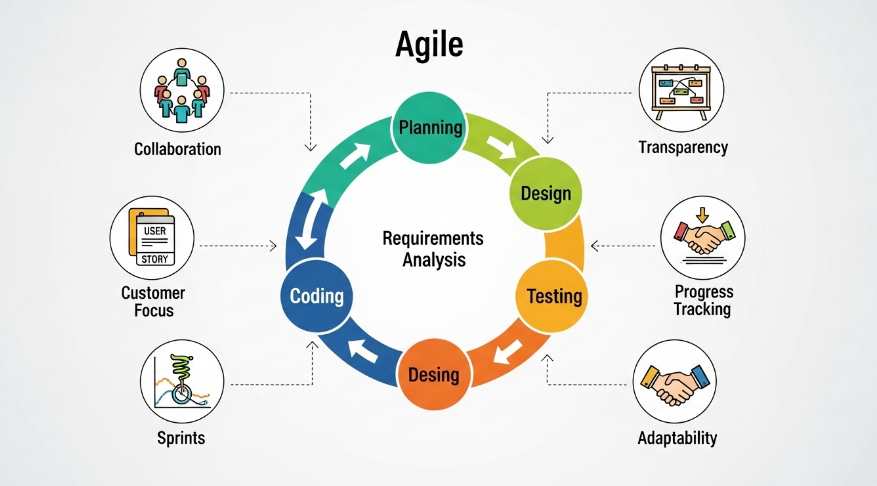
The core structure of agile software development life cycles usually includes planning, development, testing, release, and feedback — but these happen repeatedly, not just once.
How The Software Development Life Cycle In Agile Differs Structurally
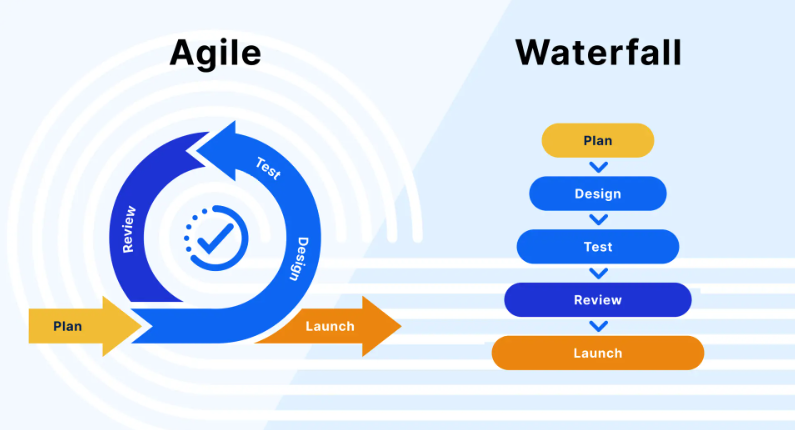
Traditional development treats software like construction. You design everything first, then build. The software development life cycle for agile treats software like evolution. You build, observe, adjust, and improve continuously.
The agile and software development life cycle approach removes rigid phase barriers. Design overlaps with development. Testing happens continuously. Business feedback flows into every sprint.
This is why the agile software development lifecycle phases explained often look less linear and more like a loop. The goal is not perfection on paper. The goal is validated working software in production.
Core Assumptions Behind The Life Cycle Of Agile Software Development
The agile life cycle phases are built on several technical and business assumptions:
These assumptions shape the agile software development life cycle stages and explain why Agile performs well in uncertain environments.
Relationship Between SDLC And The Agile Model In Software Development Life Cycle
The software development life cycle sdlc and agile methodologies relationship is not competitive. Agile is a modern implementation of SDLC principles.
The agile model in software development life cycle still includes requirements, design, coding, testing, and maintenance. The difference is execution speed and iteration frequency.
The software development life cycle and agile principles align around one shared goal: delivering reliable, maintainable software aligned with business outcomes.
Scope And Limitations Of Agile-Based SDLC Implementations
While powerful, the agile software product development life cycle is not magic. It requires:
If your organization cannot support rapid feedback loops, the agile software development agile development life cycle may require cultural transformation before delivering full value.
Let your business scale confidently while we handle operations through IT outsourcing.
Iterative And Incremental Delivery In Agile Software Development Life Cycles
Iteration means repetition with improvement. Incremental means growth through small additions. Together, they form the backbone of agile software development life cycles.
Each sprint delivers a usable software increment. This means you can test business assumptions early. Instead of launching one large product, you launch many small validated improvements.
The agile software development life cycle general steps usually include requirement selection, development, validation, and deployment inside each sprint cycle.
Continuous Feedback Loops Within The Agile Software Development Process Model
Feedback is the engine of the agile software development process steps. Without feedback, Agile becomes just fast Waterfall.
Modern Agile uses feedback from:
This is why the agile software development process model works well in dynamic industries.
Adaptive Planning In The Software Development Life Cycle For Agile
In the software development life cycle in agile, planning happens continuously. You plan long-term direction, but short-term execution changes based on new data. Adaptive planning ensures your investment follows real market signals instead of outdated assumptions.
Cross-Functional Teams And Ownership In Agile SDLC
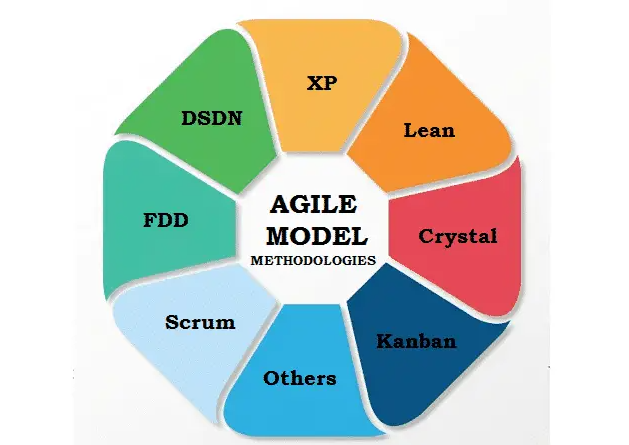
The agile kanban software development life cycle and Scrum-based models rely on cross-functional teams. This means one team can design, build, test, and deploy features independently.
For you as a decision maker, this means fewer handovers, fewer delays, and faster accountability.
Alignment With The Software Development Life Cycle And Agile Principles
The agile and software development life cycle philosophy emphasizes value delivery, technical excellence, and sustainable development pace. These principles ensure long-term product stability.
Backlog Creation And Requirements Engineering In Agile
The backlog is the central planning artifact in the agile software development process steps. It is a living list of features, improvements, and fixes.
Modern backlog engineering combines business goals, technical feasibility, and user data. At SKM Group, we treat backlog items as business hypotheses that must be validated quickly.
Sprint Planning In The Agile Software Development Agile Development Life Cycle
Sprint planning defines what will be built in the next iteration. In the agile software development agile development life cycle, planning is based on priority, team capacity, and risk level.
This ensures that the most valuable features are always built first.
Incremental Implementation And Coding Practices
Implementation in the life cycle of agile software development focuses on clean architecture, automated testing, and maintainability. Code is written for long-term evolution, not short-term delivery.
Continuous Testing Across Agile Software Development Life Cycle Stages
Testing is embedded in all agile software development life cycle stages. Automated pipelines validate code every time it changes. This protects product stability while enabling rapid releases.
Review, Retrospective, And Iteration Refinement
Each sprint ends with evaluation. Teams review delivered software and analyze process performance. This is how the agile life cycle phases continuously improve.
The agile software product development life cycle usually includes product vision definition, backlog design, sprint execution, release, and optimization. Unlike linear models, these phases repeat continuously.
The agile software development lifecycle phases explained often show overlapping activities rather than isolated blocks.
In real projects, the agile software development process diagram usually looks like a loop, not a line. Development, testing, deployment, and feedback operate simultaneously.
Real execution usually follows patterns like:
Faster Time-To-Market Through Iterative Releases
The agile software development life cycle allows you to release core features earlier. You start generating business value faster.
Change Management Advantages In Agile SDLC
The software development life cycle for agile assumes change is inevitable. Instead of resisting change, Agile structures development around it.
Quality Control In Agile Software Development Lifecycle Phases Explained
Continuous testing ensures that quality is verified throughout the agile software development lifecycle phases explained, not only at the end.
Risk Reduction Via Incremental Validation
The agile vs waterfall software development life cycle comparison clearly shows risk reduction. Agile validates assumptions continuously, while Waterfall validates at the end.
Business-IT Alignment In Agile Delivery Models
The software development life cycle agile and waterfall comparison often highlights communication gaps in traditional models. Agile reduces these gaps through continuous collaboration.
When you evaluate software development life cycle agile and waterfall, you are really deciding how your company handles uncertainty. At SKM Group, we often explain this in business terms: Waterfall assumes you know everything upfront, while Agile assumes you learn during execution.
The software development life cycle waterfall vs agile debate is not about which is universally better. It is about which model better reflects your business reality. If your product operates in a fast-moving market, the agile model in software development life cycle usually provides stronger long-term ROI.
Waterfall structures delivery around fixed scope and predefined timelines. The agile software development process model structures delivery around validated business value. This shift changes how risk, cost, and timeline interact across the project lifecycle.
In practical terms, the agile vs waterfall software development life cycle comparison shows that Agile shifts risk discovery earlier, while Waterfall often delays risk discovery until late testing phases.
Solve complex challenges with innovative, business-driven custom software development.
The agile software development life cycle is now standard across industries where technology must evolve continuously. If your business depends on customer experience, platform scalability, or regulatory adaptation, Agile becomes almost unavoidable.
Financial platforms use the life cycle of agile software development to release new compliance features quickly. Healthcare software providers rely on agile software development life cycle stages to update patient workflows safely. E-commerce companies depend on agile software product development life cycle methods to optimize conversion rates continuously.
From our experience at SKM Group, organizations typically adopt the software development life cycle in agile when digital transformation becomes core to revenue growth, not just operational support.
Linear Vs Iterative Models In SDLC
The software development life cycle waterfall vs agile distinction is most visible in delivery structure. Waterfall is linear. Agile is iterative. The agile software development process steps repeat continuously, allowing product evolution.
The what is agile life cycle question often becomes clearer here. Agile is not a replacement for SDLC. It is an iterative execution model built inside SDLC principles.
Documentation-Driven Vs Working-Software Focus
Traditional models emphasize documentation before execution. The agile software development life cycle prioritizes working software supported by necessary documentation. This supports faster decision-making and faster validation of product-market fit.
Risk Exposure In Agile Vs Waterfall Software Development Life Cycle
The agile vs waterfall software development life cycle comparison consistently shows that Agile spreads risk across iterations, while Waterfall concentrates risk near project completion. The software development life cycle for agile identifies technical and business risks early through incremental releases.
Testing Strategies Across Both Models
Waterfall testing is typically phase-based. The agile software development lifecycle phases explained integrate testing into every stage. Continuous testing improves stability while maintaining delivery speed.
Scalability And Enterprise Adoption Considerations
Large enterprises often combine governance frameworks with agile software development life cycle stages. Modern scaling frameworks allow Agile to operate in highly regulated environments without sacrificing speed.
Artificial intelligence is rapidly transforming the software development life cycle sdlc and agile methodologies landscape. The next generation of delivery models combines Agile iteration speed with predictive intelligence.
How Artificial Intelligence Enables Agile Software Development Life Cycle
Today, artificial intelligence enables agile software development life cycle optimization by automating decision support. AI analyzes historical project data, identifies delivery risks, and suggests optimal sprint scope.
At SKM Group, we see AI not as replacement for engineering judgment, but as a decision amplifier.
AI-Driven Backlog Prioritization
AI can analyze customer behavior, revenue impact, and technical complexity simultaneously. This improves backlog prioritization accuracy across the agile software development life cycle.
Predictive Analytics In Agile Planning
Predictive models estimate delivery probability, sprint velocity changes, and potential bottlenecks. This improves planning across the software development life cycle in agile.
Automated Testing In Agile Software Development Life Cycle Stages
AI-powered testing detects anomalies earlier. This strengthens reliability across agile software development life cycle stages.
Continuous Optimization Using Machine Learning
Machine learning systems optimize deployment timing, infrastructure scaling, and feature rollout strategies. This strengthens the agile software development process model over time.
The agile model in software development life cycle is now the default approach for organizations building competitive digital products. It aligns technology delivery with real business outcomes.
When you adopt the agile software development life cycle, you gain speed, adaptability, and measurable business feedback. The agile and software development life cycle approach ensures your product evolves alongside your customers and your market.
At SKM Group, we treat Agile not as methodology compliance, but as a strategic business capability. The goal is not just software delivery. The goal is predictable innovation.
Unlock new growth opportunities with full-spectrum IT services.

The main stages inside the agile software development life cycle typically include backlog creation, sprint planning, development, testing, release, and feedback integration.
You should conduct a full audit at least once a year, though quarterly mini-reviews are ideal for dynamic environments. Frequent auditing helps you identify unused or duplicated licenses early. It also strengthens your audit defense and ensures cost predictability before renewals arise.
In practice, the agile software development process diagram looks like a continuous loop of planning, building, validating, and improving.
Organizations operating in fast-changing markets benefit most from the agile software product development life cycle, especially companies building digital platforms or customer-facing software.


In our team, Dominik Bigosiński is responsible for driving the growth of online businesses through the strategic use of content. As an expert in his field, he has collaborated with organizations from the US, UK, Norway, and Poland since 2018, contributing to the development of over 100 blogs and supporting more than 450 B2B and e-commerce brands worldwide. His passion for conscious personal growth and philosophy is reflected in his work, where he focuses on delivering thoughtful, audience-centered strategies that drive long-term results.
Need tailor-made software? We build scalable, secure solutions from scratch.
Discover moreStrategic insights into technology, software development, and digital growth

Modern engineering teams are under constant pressure. They are expected to deliver faster, maintain reliable systems, operate in secure cloud environments, and achieve predictable outcomes.
Business application development is not only about writing code. It is about making the right decisions before code becomes expensive. At SKM Group, we use product roadmapping to help you turn business goals, system limits, user needs, and technology

When you invest in software, you do not pay only for features. You pay for every future change, every bug fix, every deployment, every security update, and every hour your team spends understanding the system.

When you invest in software, you are making a long-term decision that goes far beyond the initial release. The real challenge begins when your system needs to evolve—when new features are added, integrations are expanded, and existing components must
.jpg)
Poor data architecture does not always break your business systems at once. More often, it creates quiet damage: inconsistent reports, duplicated records, unclear KPIs, and decisions based on numbers nobody fully trusts.
.jpg)
Software complexity rarely appears overnight. It grows quietly with every shortcut, integration, legacy module, and undocumented business rule. At SKM Group, we see how this hidden technical weight can turn even a strong product roadmap into a slow

Your company may have many good tools. But good tools do not guarantee good communication. When business systems stop sharing data clearly, everyday work becomes slower, riskier, and harder to manage.

Every business-critical system has a second life after deployment. That life is shaped by updates, fixes, monitoring, documentation, and technical decisions that are easy to postpone.

At first, manual workflows, disconnected systems, and spreadsheets may seem manageable. But when your company begins serving more customers, processing more data, and managing more complexity, operational inefficiencies become impossible to ignore.
Modern enterprises need more than generic software subscriptions. As operations grow more complex, companies require digital infrastructure that supports automation, scalability, cybersecurity, advanced integrations, and real-time operational visibil

Modern automotive performance is no longer built only in the garage. It is built in software. Today’s vehicles rely on complex ECUs, communication protocols, telemetry systems, and real-time diagnostics that require far more than traditional mechanic

Modern companies no longer struggle with a lack of software. They struggle with too many disconnected tools, fragmented workflows, and operational processes that were never designed to work together efficiently.

If you are making decisions about modern software delivery, you will inevitably ask yourself: what is azure DevOps and why does it matter for your business? At SKM Group, we see it not as a tool, but as a structured ecosystem that connects.
.jpg)
When you invest in custom software, you are not just buying code—you are buying speed, reliability, and confidence. At SKM Group, we rely on DevOps tools as the backbone of that promise.

When you ask what is DevOps engineer, you are really asking about one of the most critical roles in modern software delivery. At SKM Group, we see a DevOps engineer not as a single function, but as a connector of systems, teams, and outcomes.
At SKM Group, you don’t just buy software—you invest in a process that determines whether your product succeeds or quietly fails in the background. One of the most transformative approaches shaping modern software delivery is DevOps.
You have heard the promise. Faster systems. Lower costs. Infinite scale. The cloud as a cure for every architectural weakness accumulated over twenty years of digital growth. And yet, from our experience at SKM Group, we have seen the opposite happen
At SKM Group, we meet organizations every week that still rely on infrastructure designed fifteen or twenty years ago. It runs. It supports operations. It feels stable. But beneath that surface, the architecture quietly expands your cybersecurity exp

Legacy systems rarely fail loudly. They age quietly. They grow around your organization like concrete poured decades ago – solid, load-bearing, but rigid. When documentation disappears, original developers leave, and integration requirements multiply
If you are responsible for technology decisions in your organization, you have probably heard both terms used almost interchangeably. Technical debt. Legacy systems. Obsolete platforms.

When you hear lean software development meaning, you should not think about a trendy buzzword. You should think about engineering discipline designed to remove friction from value delivery.
When you invest in software, you are not just buying code. You are buying speed, predictability, flexibility, and the ability to react to market change. At SKM Group, we see software as a living system, not a finished product frozen in time.

At SKM Group, we often see decision-makers pause at one deceptively simple question: what is a software development kit, and why does it matter so much to the success, cost, and scalability of your digital product?

From the perspective of SKM Group, when you ask what a mobile apps application really is, you are not asking a marketing question. You are asking an engineering question with direct business consequences.

At SKM Group, we see software resilience as the living backbone of modern digital ecosystems. It is the capability of your systems to absorb shocks, maintain essential functions, and recover faster than your business stakeholders expect.
As SKM Group, we often see that companies underestimate how deeply software dependency structures shape the long-term health of their digital products. You might assume dependencies “just work in the background,”
As SKM Group, we see every day how leaders like you face a rising paradox: you’re expected to innovate faster than ever, yet every new system you adopt must now prove its financial value with absolute clarity.

Technology doesn’t wait. Neither should you. Every software environment that powers your operations today will either evolve—or become obsolete. That’s the simple reality of digital transformation.

You’ve probably heard it before – “Customer is king.” But in 2025, that phrase isn’t just a cliché. It’s the operational truth that defines which businesses thrive and which fade into the noise.

Every industry, from manufacturing to finance, now depends on intelligent software products that enhance performance, streamline workflows, and enable long-term scalability.

When you think about the cloud, you probably imagine endless virtual servers humming somewhere in the background, waiting to process your business logic. But here’s the thing—you no longer have to.
Digital transformation isn’t a buzzword anymore—it’s your reality. You already know that running your business on outdated systems slows down growth, frustrates employees, and makes customers leave for competitors who can deliver faster.

When you sit down to plan your next digital product, one of the first questions that arises is: which app development frameworks will actually get you there?
The digital race is not about speed alone—it’s about precision, resilience, and the ability to deliver value faster than your competitors. As decision-makers in technology, you know the stakes are high.
.jpg)
When you build software, you’re not just creating a product—you’re making a promise. A promise that it will work as intended, delight its users, and deliver measurable value. But promises in software are fragile.
You’ve seen the term software scalability meaning pop up everywhere lately. But what does it really mean for your business—not just for developers? At SKM Group, we define scalability.
You know your business. You know your customers. But in today’s digital-first market, knowing isn’t enough – acting fast, adapting to trends, and delivering personalized experiences is what separates market leaders from followers

If you’re searching for ways to streamline complex builds or accelerate your software roadmap, specialized outsourcing is a smart direction. By leveraging Application Development Outsourcing or SaaS Development Outsourcing, you gain rapid access.

Your business runs on technology, whether you notice it daily or not. Choosing the right IT services shapes everything from operational resilience to your capacity for innovation.

If you're leading a business today, you're likely balancing innovation with efficiency, speed with precision, and growth with risk. That’s where specialized software outsourcing services step in — not just as a cost-saving tool, but as a strategic.

Software development processes best practices aren't just buzzwords—they are critical frameworks that shape how successful products come to life. As someone making decisions about technology investments

At SKM Group, we believe that truly successful software starts with a deep understanding of Software Engineering and Design—not just as a process, but as a discipline that brings structure
.jpg)
At SKM Group, we believe clarity is the cornerstone of successful software delivery. If you're navigating digital transformation or evaluating software partners, understanding what is software development methodology

For decision-makers managing IT outsourcing or legacy modernization, choosing between Agile and Waterfall is a financial and strategic decision. This guide explores how iterative implementation minimizes risk and accelerates ROI in distributed teams.

The ability to build a high-performance outsourcing development team can dramatically accelerate product delivery while reducing operational overhead. But to do it right, you need more than just a vendor

Offshore outsourcing software development has evolved from a cost-saving tactic into a strategic pillar for tech-driven organizations. When executed properly, it empowers you to scale faster, access niche expertise, and accelerate time-to-market with

Technology is the backbone of modern business. Whether you're a startup or an enterprise, your IT infrastructure determines how efficiently you operate, how well you serve customers, and how secure your data remains. Choosing the right IT service pro

The software development process is a structured approach to creating software, ensuring efficiency, quality, and alignment with user needs. It encompasses a series of stages, from gathering requirements to maintaining the final product.

Choosing the right business software development partner is one of the crucial decisions that might shape your company's future. With so many choices for enterprise software development companies, how will you go about making the right choice?

Choosing the right partner for your software project is a critical decision. Should you hire an individual custom software developer or collaborate with a full-fledged software development company?

Customized software solutions are the answer for companies that want to streamline operations, optimize workflows, and stay ahead. Here at SKM Group, we understand your need for tailored solutions that align with your unique goals.

Investing in custom software development can feel like navigating uncharted waters. As a decision-maker, you might wonder how custom software development costs against off-the-shelf alternatives, or whether it’s worth pursuing.

IT projects often run over budget or take too long. Agile changes that by delivering value quickly, adapting to evolving needs, and giving leaders control over costs and ROI, helping businesses stay competitive and responsive.

When embarking on a new software project, you're faced with a crucial question: will this idea work? You don’t want to spend months on development only to discover that a critical assumption was wrong.

If you've ever wondered how to create an app, you're not alone. Many businesses are seeking ways to expand their digital footprint, and a dedicated app can be a powerful tool to achieve just that.

Creating a mobile application is complex, and understanding the development cost is crucial for any business aiming to launch a successful app. With costs influenced by numerous variables, knowing what affects your budget and where your money goes

Having a clear, structured approach is essential. Whether you're diving into your first project or overseeing a complex, custom build, the journey can feel overwhelming.

Understanding what is a software life cycle is crucial. The term encapsulates every phase a software product goes through, from inception to retirement. At SKM Group, when you understand this life cycle deeply.

Encountering technical problems is inevitable in our tech-driven lives. This article outlines basic steps to troubleshoot common issues like internet connectivity, software bugs, and peripheral device problems.

Comments