


You have heard the promise. Faster systems. Lower costs. Infinite scale. The cloud as a cure for every architectural weakness accumulated over twenty years of digital growth. And yet, from our experience at SKM Group, we have seen the opposite happen more times than most companies are willing to admit. Cloud migration initiatives that were meant to modernize infrastructure instead amplified legacy inefficiencies, increased operational risk, and deepened technical debt.
Before discussing failure, we must define the subject with technical accuracy.
Cloud migration in cloud computing is the structured process of transferring applications, infrastructure, databases, integrations, and operational workflows from on-premises or hybrid environments to cloud-based platforms. This includes not only infrastructure relocation, but architectural redesign, operational change, governance adaptation, and data movement.
At SKM Group, we treat migration not as infrastructure relocation, but as architectural transformation. If you define it narrowly, you will execute it narrowly — and that is where failure begins.
Cloud Migration Definition And Core Architectural Principles
A professional cloud migration definition must include:
If your project only copies virtual machines from a data center to a cloud provider, you are not transforming architecture. You are relocating constraints.
The real value of cloud migration benefits lies in adopting distributed systems principles: stateless services, asynchronous processing, managed databases, auto-scaling, observability-first operations. Without those changes, the cloud becomes an expensive hosting environment.
You must understand this clearly: the cloud does not fix architecture. It exposes it.
The Role Of Cloud Migration Assessment In Infrastructure Modernization
A structured cloud migration assessment is the most underestimated phase in the entire cloud migration journey. It is not a spreadsheet exercise. It is a forensic architectural analysis.
When we conduct an assessment at SKM Group, we evaluate:
Without proper cloud migration assessment tools, organizations make assumptions. Assumptions about performance. About compatibility. About licensing. About scalability.
Assumptions are expensive.
You cannot modernize infrastructure without understanding what you are moving, why you are moving it, and how it behaves under stress.
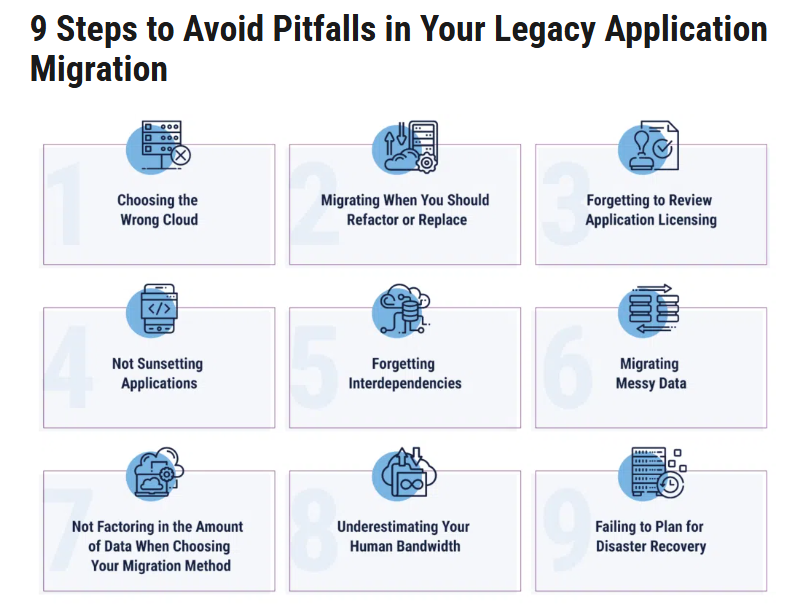
Differences Between On-Premises Refactoring And Cloud Workload Migration
There is a critical distinction between refactoring systems on-premises and executing cloud workload migration.
On-prem refactoring often optimizes performance within fixed hardware boundaries. It improves code, reduces coupling, and modernizes libraries. But it still assumes static capacity.
Cloud migration, by contrast, introduces dynamic infrastructure. That changes system behavior. Auto-scaling groups react to load. Managed services introduce latency trade-offs. Distributed storage shifts consistency models.
When companies confuse refactoring with cloud migration techniques, they underestimate complexity. They move a monolith to the cloud and expect elasticity without decomposition. That rarely works.
Where Cloud Migration Data Fits In Enterprise Architecture
Cloud migration data strategy is not just about moving databases. It is about redefining data gravity.
Legacy systems often rely on tightly coupled relational schemas with synchronous transactions across services. When migrated without redesign, these patterns generate cross-zone latency and high egress costs.
Data in the cloud lives in layers:
If you move everything without segmentation, you increase latency and operational cost. Data gravity pulls workloads back into inefficient architectures.
Your enterprise architecture must redefine data domains before migration begins.
How Cloud Migration Solutions Interact With Legacy Systems
Modern cloud migration solutions promise automation. Discovery scanners. Automated rehosting. Containerization engines.
But tools do not understand business logic.
Legacy systems often depend on undocumented integrations — batch jobs, FTP transfers, internal APIs built a decade ago. If your cloud migration methodology does not map these dependencies, you risk breaking critical workflows.
Automation accelerates execution. It does not replace architectural judgment.
Reduce overhead and complexity through strategic IT outsourcing.
The industry narrative around cloud migration benefits is optimistic. Lower costs. Higher resilience. Better scalability.
But when migration is misaligned with architecture, the result is regression.
At SKM Group, we have audited environments where performance degraded by 40% after migration. Costs doubled. Incident frequency increased.
The gap between promise and reality is not caused by the cloud. It is caused by poor cloud migration considerations.
Performance Regression After Improper Cloud Migration AWS Implementations
Improper cloud migration aws projects often rely on “lift and shift” models without optimization. Virtual machines are copied directly to EC2. Monolithic databases are placed into managed services without indexing redesign.
In distributed environments, network latency matters. Cross-region communication adds milliseconds that accumulate under load.
We have seen organizations:
Each of these mistakes turns theoretical scalability into practical bottlenecks.
Cloud infrastructure is not inherently faster. It is conditionally scalable.
Technical Debt Amplification During The Cloud Migration Journey
A poorly structured cloud migration project plan does not eliminate technical debt. It migrates it.
Worse, it compounds it.
When outdated frameworks are containerized without refactoring, you create legacy inside modern infrastructure. When undocumented processes are automated blindly, you lock inefficiencies into code.
The cloud migration journey becomes an amplifier. Every architectural flaw becomes more visible, more expensive, more difficult to correct.
At SKM Group, we often say: migrate clarity, not confusion.
Misaligned Infrastructure Strategy And Poor Cloud Migration Considerations
Infrastructure strategy must align with business goals. If your cloud migration business objective is cost reduction, but your architecture requires high-performance compute clusters, the math will not work.
Many organizations fail because they:
A migration without strategic alignment becomes an operational experiment. And production systems should never be experiments.
Latency, Data Gravity, And Cloud Migration Risks
Latency is physics. It does not negotiate.
When legacy systems assume sub-millisecond local database access, moving those databases to a distributed cloud environment changes transaction speed.
Cloud migration risks increase when data gravity is ignored. If data resides in one region but services scale across others, network overhead grows.
In regulated industries, regional data residency requirements add further constraints. Ignoring these factors leads to compliance exposure and user dissatisfaction.
Migration must model latency before execution, not after complaints.
Security Architecture Failures In Early-Stage Cloud Migration Approaches
Early cloud migration approaches often prioritize speed. Security is treated as configuration, not architecture.
Cloud platforms operate on shared responsibility models. Identity and access management, encryption, network segmentation — these must be designed from day one.
We have audited projects where:
Security debt in the cloud multiplies quickly. Visibility increases, but so does exposure.
Cost Overruns And Governance Failures In The Cloud Migration Business Context
The final shock often appears in financial reports.
The cloud migration services market promotes flexibility, but without governance controls, elasticity becomes uncontrolled spending.
Common failures include:
The result? Cloud bills exceeding on-prem infrastructure costs within months.
This is not a failure of technology. It is a failure of governance within the broader cloud migration business strategy.
When a cloud migration project plan fails, it rarely collapses because of one dramatic error. It fails because of structural weaknesses that were invisible at kickoff and undeniable at scale.
At SKM Group, we have reviewed dozens of transformation initiatives where the roadmap looked professional, the vendors were credible, and the budget was approved — yet the execution created instability instead of modernization.
Failure leaves fingerprints. You only need to know where to look.
Incomplete Cloud Migration Assessment Tools Usage
Many organizations invest in cloud migration assessment tools, but they use them superficially. Discovery scans are executed once. Dependency maps are generated but not validated. Performance metrics are sampled during low-traffic periods.
A real cloud migration assessment requires multi-layer validation. Automated outputs must be reviewed by architects who understand runtime behavior, concurrency patterns, and edge-case traffic.
Tools reveal structure. They do not interpret risk.
When assessment data is incomplete, every downstream decision — sizing, cost modeling, workload placement — is based on partial truth. That is how performance regression begins before the first workload moves.
Ignoring Legacy System Dependencies During Cloud Migration Methodology Design
Legacy systems rarely operate in isolation. They are ecosystems.
A flawed cloud migration methodology treats applications as independent units. In reality, they often share databases, background jobs, authentication mechanisms, reporting pipelines, and file storage.
We have seen migrations where a reporting service was moved to the cloud, but its database remained on-premises. The result was cross-network latency and failed batch processes. Not because the cloud was wrong — but because dependency mapping was incomplete.
Your methodology must map technical and operational dependencies. Otherwise, migration fragments systems that were designed to function together.
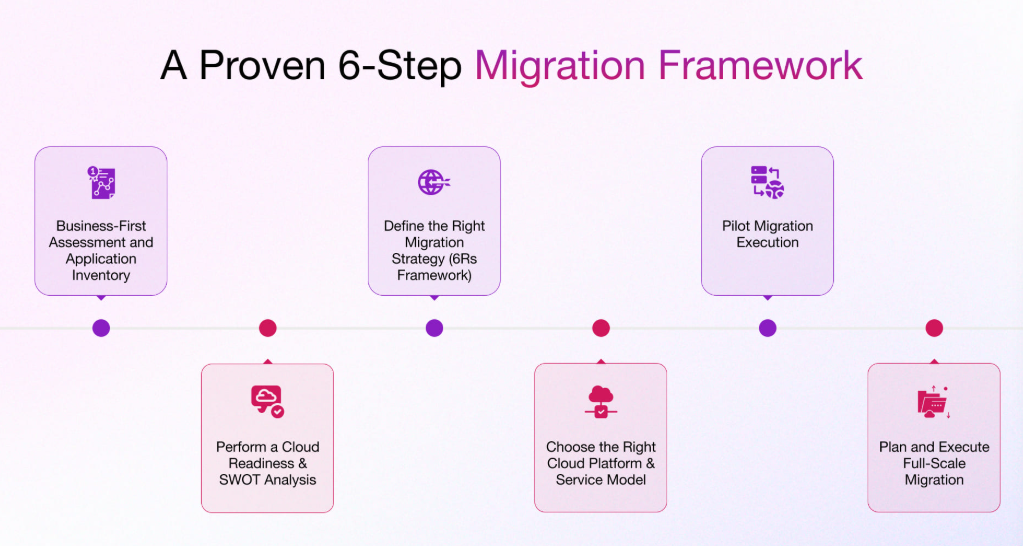
Underestimating Data Complexity In Cloud Migration Data Transfers
Cloud migration data transfer is frequently reduced to bandwidth calculations. But data complexity is not just about volume. It is about structure, consistency models, transformation logic, and downtime tolerance.
Legacy databases often contain:
When you migrate data without analyzing these elements, you risk functional failure even if the transfer completes successfully.
At SKM Group, we insist on modeling data behavior under load in the target environment before executing production transfers. Data movement must be rehearsed, not improvised.
Tool Sprawl And Poorly Defined Cloud Migration Tools List
The market offers an endless cloud migration tools list. Automated rehosting platforms. Containerization engines. Monitoring suites. Cost analyzers.
Without architectural discipline, organizations adopt too many tools too quickly. Each tool introduces configuration complexity and operational learning curves.
Tool sprawl creates three problems:
Effective migration requires a curated stack, not a crowded toolbox.
Lack Of Technical Validation From Cloud Migration Service Providers
Not all cloud migration service providers operate at the same level of architectural rigor.
Some focus on speed and contract value. Few emphasize long-term maintainability and technical debt reduction.
When external partners are selected based on cost or timeline alone, validation suffers. Architectural decisions are not stress-tested. Risk models are not challenged.
At SKM Group, we believe a migration partner must be willing to slow down execution if architecture demands it. Speed without validation is acceleration toward instability.
Enterprise legacy environments amplify cloud migration challenges because they were not designed for elasticity or distributed systems.
Monoliths depend on shared memory models. Batch jobs assume predictable execution windows. Authentication systems rely on internal directories.
When you introduce dynamic infrastructure, autoscaling nodes, and regionally distributed storage, these assumptions break.
The most common enterprise obstacles include rigid release cycles, undocumented integrations, regulatory constraints, and resistance to operational change.
Cloud is not only a technical shift. It is an organizational shift. And organizations resist disruption.
Turn ideas into high-performing platforms with expert Custom software development.
Standard cloud migration approaches often prioritize rehosting. Lift and shift. Minimal code change. Quick timeline.
This works for stateless services. It fails for monoliths.
Monolithic systems assume:
Moving such systems to cloud infrastructure without decomposition transfers architectural rigidity into a distributed environment.
Elastic compute does not compensate for architectural coupling. It only masks it temporarily.
If you migrate a monolith without redefining boundaries, you create a cloud-hosted monolith — more expensive, not more scalable.
Addressing cloud migration challenges and solutions requires structured intervention, not reactive troubleshooting.
Mitigation begins before execution and continues long after go-live.
Implementing Structured Cloud Migration Best Practices
Professional cloud migration best practices are grounded in sequence and discipline.
At SKM Group, we define mandatory controls:
These controls reduce uncertainty. They replace optimism with data.
Selecting The Right Cloud Migration Types For Legacy Modernization
There are several cloud migration types — rehost, replatform, refactor, repurchase, retire, retain.
Choosing the wrong type for the wrong system is a strategic error.
Rehosting may be acceptable for low-risk internal tools. Refactoring is often necessary for revenue-critical systems. Replatforming can balance speed and modernization when applied correctly.
Selecting among cloud migration techniques must reflect business criticality, compliance requirements, and architectural maturity.
Using Automated Cloud Migration Software For Dependency Mapping
Advanced cloud migration software can model runtime interactions across applications. It captures API calls, database queries, and inter-service communication.
When combined with manual validation, it reduces blind spots.
A professional cloud migration assistant platform should provide:
Automation supports judgment. It does not replace it.
Phased Refactoring With Controlled Cloud Workload Migration
Instead of large-scale relocation, phased cloud workload migration reduces risk.
Workloads are migrated in controlled waves. Each wave includes validation, monitoring, and performance comparison against baseline metrics.
This approach allows you to observe behavior changes incrementally. It creates space to correct architecture before systemic impact occurs.
Modernization becomes iterative, not disruptive.
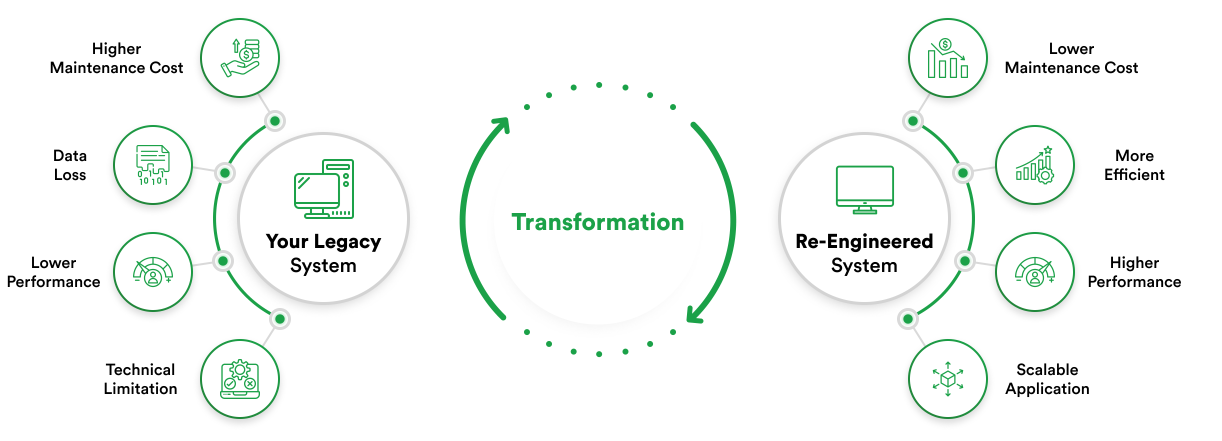
Risk Modeling And Compliance Validation To Reduce Cloud Migration Risks
Reducing cloud migration risks requires quantitative modeling.
Latency simulations. Failure injection testing. Disaster recovery rehearsal. Compliance audits aligned with industry frameworks.
Risk cannot be eliminated. But it can be modeled, measured, and mitigated.
Migration without risk modeling is speculation.
Leveraging Expert Cloud Migration Service Providers For Complex Systems
Complex enterprise systems demand experienced cloud migration service providers who understand distributed systems theory, compliance frameworks, and financial governance.
You should involve external expertise when:
The right partner protects your strategic assets. The wrong one accelerates exposure.
The cloud migration services market is expanding rapidly. Providers promise speed, automation, and transformation at scale.
But the market’s growth creates noise. Marketing often overshadows engineering depth.
As a decision-maker, you must distinguish between infrastructure relocation vendors and architectural transformation partners.
True transformation requires understanding your business model, your regulatory environment, your data sensitivity, and your long-term technology roadmap.
Cloud is not a product. It is an operating model.
Drive measurable results with reliable IT services.
We have observed multiple cloud migration use cases where expectations diverged from outcomes.
One financial services firm migrated a trading analytics platform without redesigning database indexing. Query times doubled. Traders experienced delays during peak hours.
A healthcare provider moved patient record systems to the cloud but failed to model cross-region latency. Compliance audits identified data residency violations.
A manufacturing enterprise rehosted ERP systems without decomposing batch workflows. Nightly processing windows extended into business hours, disrupting operations.
In each case, the cloud was not the problem. The absence of structured methodology was.
At SKM Group, we apply a structured cloud migration methodology designed to protect legacy systems from degradation.
It is not built for speed. It is built for resilience.
Phase 1: Deep-Dive Cloud Migration Assessment And Architecture Baseline
We begin with comprehensive cloud migration assessment.
This includes dependency mapping, workload profiling, cost modeling, security audits, and regulatory validation.
The objective is to establish an architecture baseline. You cannot improve what you do not measure.
Phase 2: Selecting The Correct Cloud Migration Techniques (Rehost, Replatform, Refactor)
We then evaluate appropriate cloud migration techniques for each workload.
Not every system requires full refactoring. Not every system can tolerate rehosting.
Technique selection aligns technical feasibility with business risk tolerance.
Phase 3: Structured Cloud Migration Project Plan With Risk Controls
The cloud migration project plan is developed with embedded risk controls.
Milestones include validation gates, rollback strategies, performance benchmarks, and financial checkpoints.
Execution proceeds only when predefined criteria are satisfied.
Phase 4: Execution Using Verified Cloud Migration Assistant And Automation Tools
Migration execution leverages validated cloud migration software and a controlled cloud migration assistant stack.
Automation is audited. Configurations are reviewed. Security is validated continuously.
Execution is disciplined, not rushed.
Phase 5: Post-Migration Optimization And Continuous Cloud Migration Best Practices Enforcement
After go-live, optimization begins.
We enforce cloud migration best practices through monitoring, cost governance, performance tuning, and architecture review cycles.
Migration is not complete at deployment. It is complete when the system operates better than before.
Phase 6: Governance Alignment Within The Broader Cloud Migration Business Strategy
Finally, migration aligns with broader cloud migration business strategy.
FinOps governance. Security oversight. Compliance reporting. Executive visibility.
Technology must support business stability. Not destabilize it.
Cloud transformation is powerful. But power without precision creates risk.
When poorly executed, cloud migration amplifies legacy weaknesses. It increases cost. It reduces predictability. It exposes compliance gaps.
When executed with architectural discipline, structured assessment, and strategic alignment, it becomes a platform for resilience and scalability.
At SKM Group, we do not sell migration as a shortcut. We design it as a controlled evolution.
If you are considering transformation, your first responsibility is not speed. It is clarity.

The most frequent cloud migration challenges include tightly coupled architectures, undocumented dependencies, rigid database schemas, compliance constraints, and lack of internal cloud-native expertise. These factors increase operational and financial risk if not addressed early.
Professional cloud migration assessment tools identify dependencies, workload characteristics, and security gaps before migration begins.
They reduce uncertainty by replacing assumptions with measurable data.
For monoliths, phased refactoring combined with selective replatforming is typically safer than pure rehosting.
This allows incremental modernization while preserving business continuity.
A disciplined cloud migration project plan embeds validation gates, architecture reviews, and performance benchmarks.
By enforcing structure, it prevents legacy inefficiencies from being containerized without correction.


In our team, Dominik Bigosiński is responsible for driving the growth of online businesses through the strategic use of content. As an expert in his field, he has collaborated with organizations from the US, UK, Norway, and Poland since 2018, contributing to the development of over 100 blogs and supporting more than 450 B2B and e-commerce brands worldwide. His passion for conscious personal growth and philosophy is reflected in his work, where he focuses on delivering thoughtful, audience-centered strategies that drive long-term results.
Need tailor-made software? We build scalable, secure solutions from scratch.
Discover moreStrategic insights into technology, software development, and digital growth

Modern engineering teams are under constant pressure. They are expected to deliver faster, maintain reliable systems, operate in secure cloud environments, and achieve predictable outcomes.

Business application development is not only about writing code. It is about making the right decisions before code becomes expensive. At SKM Group, we use product roadmapping to help you turn business goals, system limits, user needs, and technology

When you invest in software, you do not pay only for features. You pay for every future change, every bug fix, every deployment, every security update, and every hour your team spends understanding the system.

When you invest in software, you are making a long-term decision that goes far beyond the initial release. The real challenge begins when your system needs to evolve—when new features are added, integrations are expanded, and existing components must

Poor data architecture does not always break your business systems at once. More often, it creates quiet damage: inconsistent reports, duplicated records, unclear KPIs, and decisions based on numbers nobody fully trusts.

Software complexity rarely appears overnight. It grows quietly with every shortcut, integration, legacy module, and undocumented business rule. At SKM Group, we see how this hidden technical weight can turn even a strong product roadmap into a slow

Your company may have many good tools. But good tools do not guarantee good communication. When business systems stop sharing data clearly, everyday work becomes slower, riskier, and harder to manage.

Every business-critical system has a second life after deployment. That life is shaped by updates, fixes, monitoring, documentation, and technical decisions that are easy to postpone.

At first, manual workflows, disconnected systems, and spreadsheets may seem manageable. But when your company begins serving more customers, processing more data, and managing more complexity, operational inefficiencies become impossible to ignore.

Modern enterprises need more than generic software subscriptions. As operations grow more complex, companies require digital infrastructure that supports automation, scalability, cybersecurity, advanced integrations, and real-time operational visibil

Modern automotive performance is no longer built only in the garage. It is built in software. Today’s vehicles rely on complex ECUs, communication protocols, telemetry systems, and real-time diagnostics that require far more than traditional mechanic

Modern companies no longer struggle with a lack of software. They struggle with too many disconnected tools, fragmented workflows, and operational processes that were never designed to work together efficiently.

If you are making decisions about modern software delivery, you will inevitably ask yourself: what is azure DevOps and why does it matter for your business? At SKM Group, we see it not as a tool, but as a structured ecosystem that connects.

When you invest in custom software, you are not just buying code—you are buying speed, reliability, and confidence. At SKM Group, we rely on DevOps tools as the backbone of that promise.

When you ask what is DevOps engineer, you are really asking about one of the most critical roles in modern software delivery. At SKM Group, we see a DevOps engineer not as a single function, but as a connector of systems, teams, and outcomes.

At SKM Group, you don’t just buy software—you invest in a process that determines whether your product succeeds or quietly fails in the background. One of the most transformative approaches shaping modern software delivery is DevOps.
You have heard the promise. Faster systems. Lower costs. Infinite scale. The cloud as a cure for every architectural weakness accumulated over twenty years of digital growth. And yet, from our experience at SKM Group, we have seen the opposite happen

At SKM Group, we meet organizations every week that still rely on infrastructure designed fifteen or twenty years ago. It runs. It supports operations. It feels stable. But beneath that surface, the architecture quietly expands your cybersecurity exp

Legacy systems rarely fail loudly. They age quietly. They grow around your organization like concrete poured decades ago – solid, load-bearing, but rigid. When documentation disappears, original developers leave, and integration requirements multiply

If you are responsible for technology decisions in your organization, you have probably heard both terms used almost interchangeably. Technical debt. Legacy systems. Obsolete platforms.

When you hear lean software development meaning, you should not think about a trendy buzzword. You should think about engineering discipline designed to remove friction from value delivery.

When you invest in software, you are not just buying code. You are buying speed, predictability, flexibility, and the ability to react to market change. At SKM Group, we see software as a living system, not a finished product frozen in time.

At SKM Group, we often see decision-makers pause at one deceptively simple question: what is a software development kit, and why does it matter so much to the success, cost, and scalability of your digital product?

From the perspective of SKM Group, when you ask what a mobile apps application really is, you are not asking a marketing question. You are asking an engineering question with direct business consequences.

At SKM Group, we see software resilience as the living backbone of modern digital ecosystems. It is the capability of your systems to absorb shocks, maintain essential functions, and recover faster than your business stakeholders expect.

As SKM Group, we often see that companies underestimate how deeply software dependency structures shape the long-term health of their digital products. You might assume dependencies “just work in the background,”
As SKM Group, we see every day how leaders like you face a rising paradox: you’re expected to innovate faster than ever, yet every new system you adopt must now prove its financial value with absolute clarity.

Technology doesn’t wait. Neither should you. Every software environment that powers your operations today will either evolve—or become obsolete. That’s the simple reality of digital transformation.

You’ve probably heard it before – “Customer is king.” But in 2025, that phrase isn’t just a cliché. It’s the operational truth that defines which businesses thrive and which fade into the noise.

Every industry, from manufacturing to finance, now depends on intelligent software products that enhance performance, streamline workflows, and enable long-term scalability.

When you think about the cloud, you probably imagine endless virtual servers humming somewhere in the background, waiting to process your business logic. But here’s the thing—you no longer have to.

Digital transformation isn’t a buzzword anymore—it’s your reality. You already know that running your business on outdated systems slows down growth, frustrates employees, and makes customers leave for competitors who can deliver faster.

When you sit down to plan your next digital product, one of the first questions that arises is: which app development frameworks will actually get you there?
The digital race is not about speed alone—it’s about precision, resilience, and the ability to deliver value faster than your competitors. As decision-makers in technology, you know the stakes are high.

When you build software, you’re not just creating a product—you’re making a promise. A promise that it will work as intended, delight its users, and deliver measurable value. But promises in software are fragile.

You’ve seen the term software scalability meaning pop up everywhere lately. But what does it really mean for your business—not just for developers? At SKM Group, we define scalability.

You know your business. You know your customers. But in today’s digital-first market, knowing isn’t enough – acting fast, adapting to trends, and delivering personalized experiences is what separates market leaders from followers

If you’re searching for ways to streamline complex builds or accelerate your software roadmap, specialized outsourcing is a smart direction. By leveraging Application Development Outsourcing or SaaS Development Outsourcing, you gain rapid access.

Your business runs on technology, whether you notice it daily or not. Choosing the right IT services shapes everything from operational resilience to your capacity for innovation.

If you're leading a business today, you're likely balancing innovation with efficiency, speed with precision, and growth with risk. That’s where specialized software outsourcing services step in — not just as a cost-saving tool, but as a strategic.

Software development processes best practices aren't just buzzwords—they are critical frameworks that shape how successful products come to life. As someone making decisions about technology investments

At SKM Group, we believe that truly successful software starts with a deep understanding of Software Engineering and Design—not just as a process, but as a discipline that brings structure

At SKM Group, we believe clarity is the cornerstone of successful software delivery. If you're navigating digital transformation or evaluating software partners, understanding what is software development methodology

For decision-makers managing IT outsourcing or legacy modernization, choosing between Agile and Waterfall is a financial and strategic decision. This guide explores how iterative implementation minimizes risk and accelerates ROI in distributed teams.

The ability to build a high-performance outsourcing development team can dramatically accelerate product delivery while reducing operational overhead. But to do it right, you need more than just a vendor

Offshore outsourcing software development has evolved from a cost-saving tactic into a strategic pillar for tech-driven organizations. When executed properly, it empowers you to scale faster, access niche expertise, and accelerate time-to-market with

Technology is the backbone of modern business. Whether you're a startup or an enterprise, your IT infrastructure determines how efficiently you operate, how well you serve customers, and how secure your data remains. Choosing the right IT service pro

The software development process is a structured approach to creating software, ensuring efficiency, quality, and alignment with user needs. It encompasses a series of stages, from gathering requirements to maintaining the final product.

Choosing the right business software development partner is one of the crucial decisions that might shape your company's future. With so many choices for enterprise software development companies, how will you go about making the right choice?

Choosing the right partner for your software project is a critical decision. Should you hire an individual custom software developer or collaborate with a full-fledged software development company?

Customized software solutions are the answer for companies that want to streamline operations, optimize workflows, and stay ahead. Here at SKM Group, we understand your need for tailored solutions that align with your unique goals.

Investing in custom software development can feel like navigating uncharted waters. As a decision-maker, you might wonder how custom software development costs against off-the-shelf alternatives, or whether it’s worth pursuing.

IT projects often run over budget or take too long. Agile changes that by delivering value quickly, adapting to evolving needs, and giving leaders control over costs and ROI, helping businesses stay competitive and responsive.

When embarking on a new software project, you're faced with a crucial question: will this idea work? You don’t want to spend months on development only to discover that a critical assumption was wrong.

If you've ever wondered how to create an app, you're not alone. Many businesses are seeking ways to expand their digital footprint, and a dedicated app can be a powerful tool to achieve just that.

Creating a mobile application is complex, and understanding the development cost is crucial for any business aiming to launch a successful app. With costs influenced by numerous variables, knowing what affects your budget and where your money goes

Having a clear, structured approach is essential. Whether you're diving into your first project or overseeing a complex, custom build, the journey can feel overwhelming.

Understanding what is a software life cycle is crucial. The term encapsulates every phase a software product goes through, from inception to retirement. At SKM Group, when you understand this life cycle deeply.

Encountering technical problems is inevitable in our tech-driven lives. This article outlines basic steps to troubleshoot common issues like internet connectivity, software bugs, and peripheral device problems.

Comments